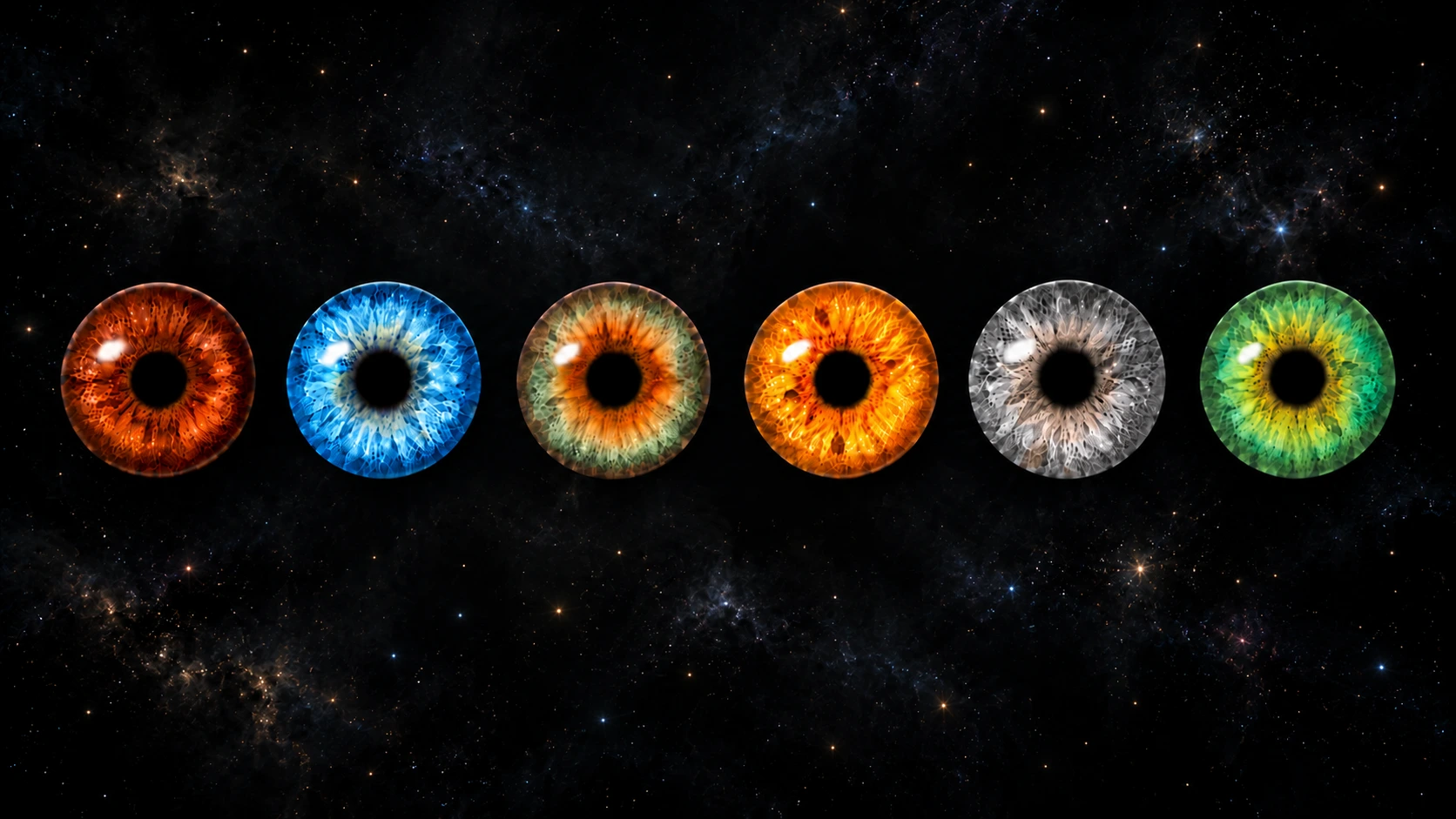
Your eye color may seem like a simple label such as brown, blue, green, or hazel, but there is much more variation than those categories suggest. In fact, a Stanford Newborn Eye Screening Test study found that 63% of 192 newborns had brown eyes at birth, compared with 20.8% with blue eyes, showing just how early differences in human eye colors can appear.
What makes your eyes look uniquely yours comes down to more than one gene or one amount of pigment. Eye color develops along a spectrum as melanin, iris structure, and multiple genes interact, with OCA2 and HERC2 playing especially important roles. That combination helps explain why two people placed in the same eye-color category can still have noticeably different shades, rings, flecks, and undertones.
If you simply want to experiment with how your eye color looks, color contact lenses online can provide a temporary change when they are prescribed and properly fitted for your eyes.
Types of Eye Colors
Most human eye colors fall into six commonly recognized groups: brown eyes, blue eyes, hazel eyes, green eyes, gray eyes, and amber eyes. Each category includes a wide range of shades and iris patterns, so eye color exists on a continuum rather than in six perfectly separate boxes.
This quick eye color chart can help you compare the main categories at a glance. The descriptions are general because real irises often include variations that do not fit neatly into a single label.
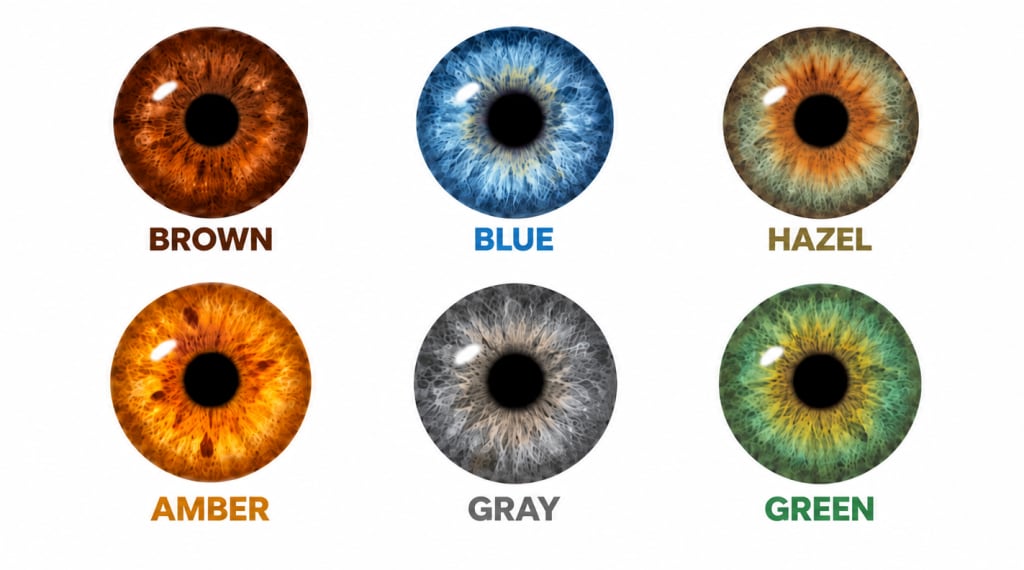
Note: Natural eye colors do not always fit perfectly into one category. Lighting, surrounding colors, iris patterns, and the distribution of pigmentation can make the same eyes look somewhat different under different conditions.
Brown Eyes
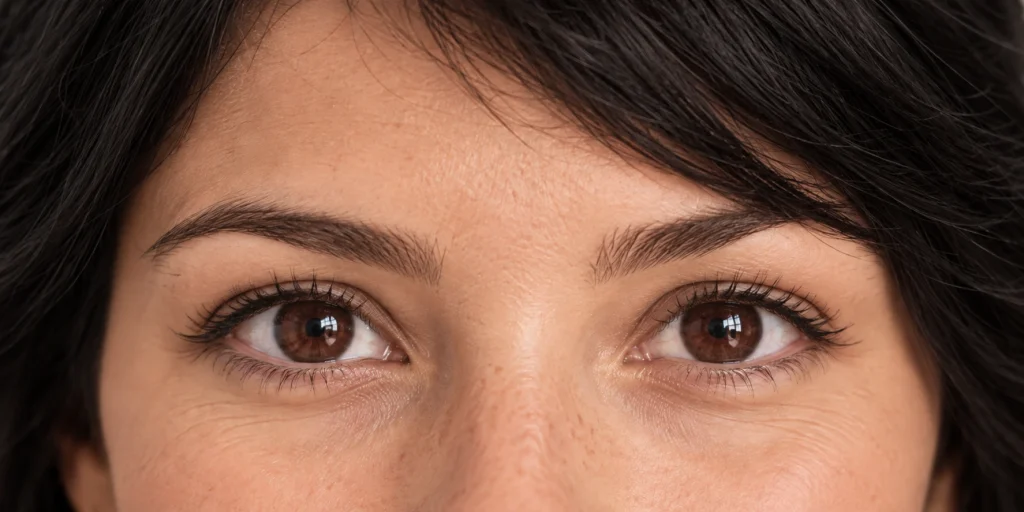
Brown eyes are the most common eye color worldwide, with estimates placing them at about 70% to 80% of the global population. If your eyes are brown, their shade can range from light golden brown to nearly black because brown irises generally contain more melanin in their front layers than lighter-colored eyes, and greater amounts of melanin usually create a deeper appearance. Even within this broad color group, your iris is highly individual, and Cleveland Clinic notes that no two people have eyes with exactly the same colors.
For a deeper look at their pigmentation, genetics, patterns, and other characteristics, explore these facts about brown eyes.
Blue Eyes
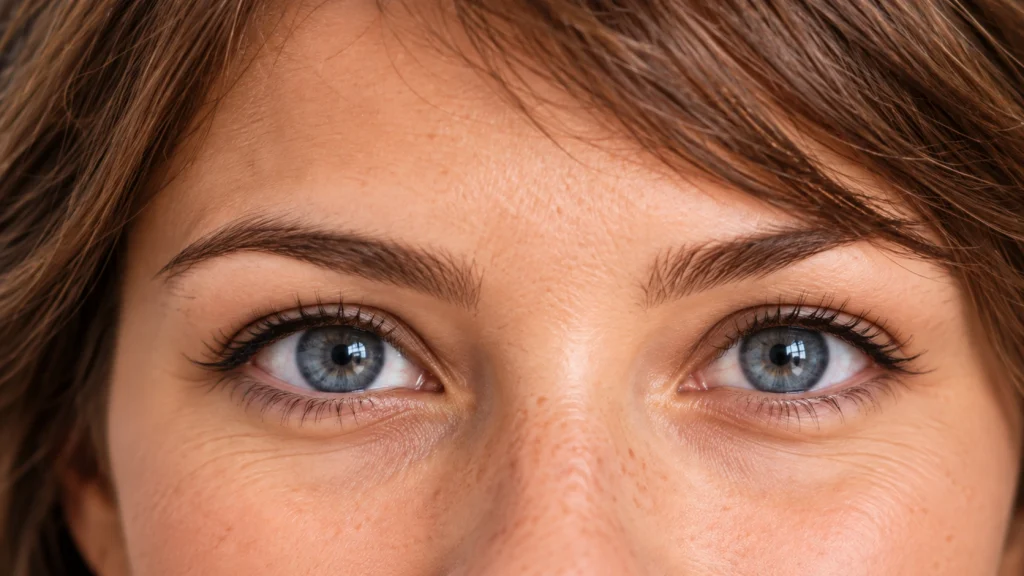
Blue eyes are the second most common eye color worldwide, with estimates placing them at about 8% to 10% of the global population. If your eyes are blue, their color comes from relatively low melanin levels in the front layers of the iris and the way light scatters through its structure, rather than from a blue pigment. Blue eyes are especially common in northern and eastern Europe, although they also occur in populations across other regions. Their appearance can range from pale blue to deeper blue-gray depending on iris structure, lighting, and surrounding colors.
Hazel Eyes
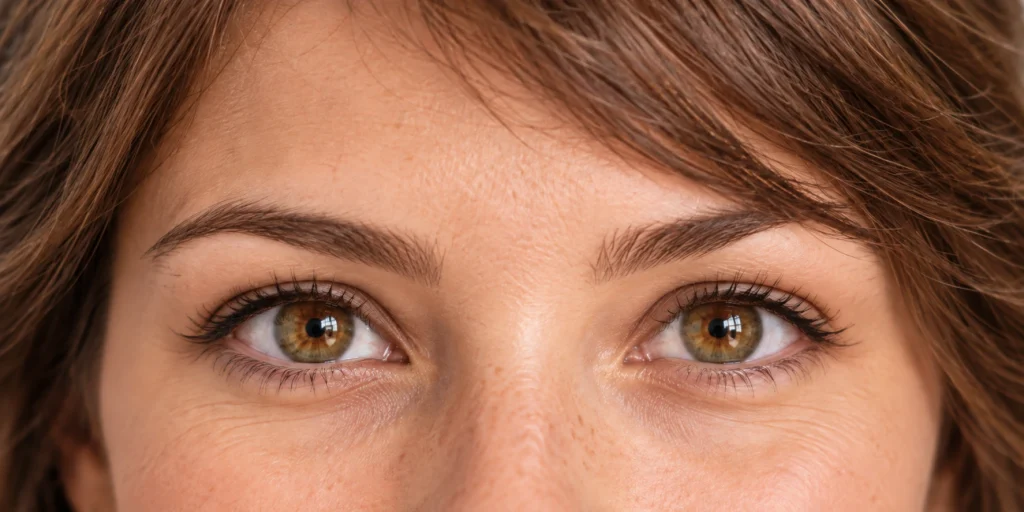
Hazel eyes are estimated to occur in about 5% of the global population, making them much less common than brown or blue eyes. If your eyes are hazel, they usually show a visible mix of brown, green, and/or gold rather than one uniform color across the iris. The balance of those colors can vary widely, which is why one person’s hazel eyes may look more green while others appear more brown or golden. Lighting and pupil size can also make the different tones stand out more strongly, creating the impression that hazel eyes shift color.
Want to understand why hazel eyes can contain several visible colors? Learn what makes hazel eyes unique and how their brown, green, and gold tones can vary.
Amber Eyes
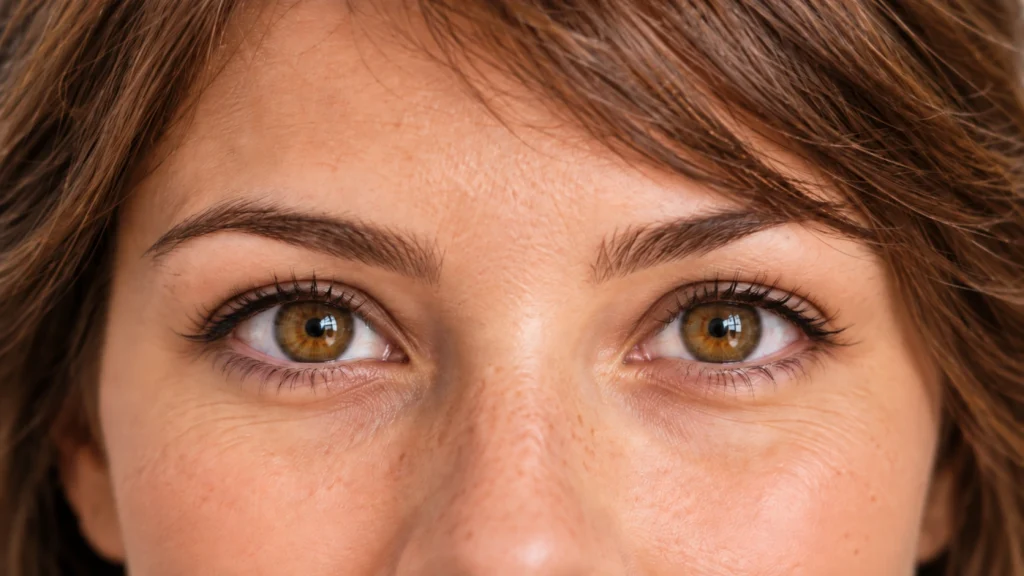
Amber eyes make up roughly 5% of the world’s population, so they are far less common than brown or blue eyes. If your eyes are amber, they usually have a fairly uniform golden, yellow-brown, or copper tone instead of the more mixed pattern often seen in hazel eyes. Their warm appearance comes from the pigments present in the iris and the way light interacts with them. Depending on the lighting, amber eyes may look more golden, honey-colored, or copper while still keeping a consistent overall hue.
Green Eyes
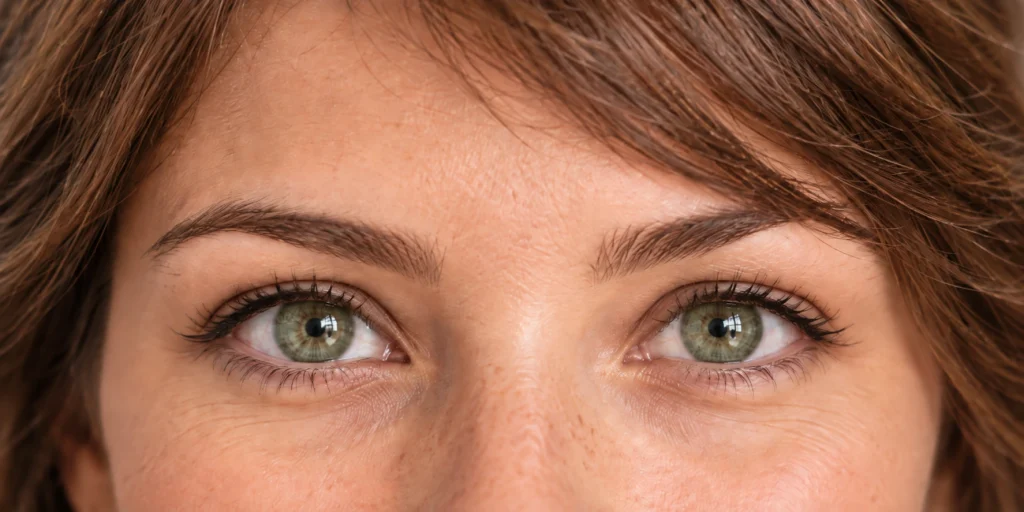
Green eyes are among the rarest natural eye colors, representing about 2% of the world’s population. If your eyes are green, their color comes from relatively low levels of melanin in the iris combined with the way light scatters through its structure, rather than from a true green pigment. Green shades can range from muted olive and gray-green to brighter, more noticeable tones, and may appear slightly different depending on lighting and surrounding colors. They are found most often in people with Northern, Central, or Western European ancestry, although green eyes can occur in populations around the world.
Gray Eyes
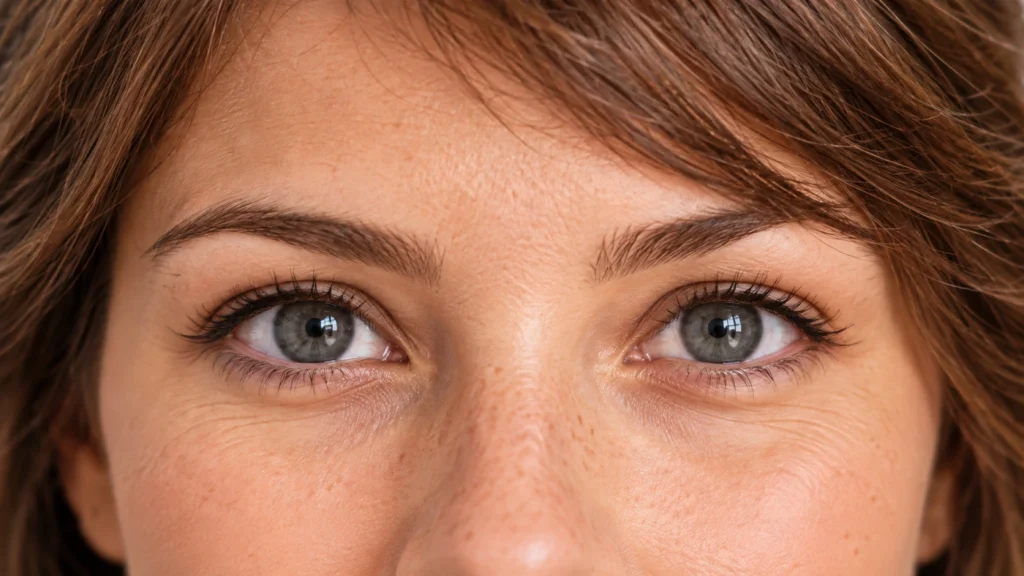
Gray eyes account for about 3% of the world’s population, making them one of the least common natural eye colors. If your eyes are gray, they usually contain very little melanin in the front of the iris, and their silvery or smoky appearance comes largely from the way light interacts with the iris structure. Gray eyes can appear silver, blue-gray, or green-gray, which is why they may be mistaken for blue or green under certain lighting. Their appearance can also shift subtly with changes in light, pupil size, and surrounding colors without the iris itself actually changing color.
What Determines Eye Color
Your eye color comes from the iris, especially differences in melanin amount and distribution, iris structure, genetics, and the way incoming light is absorbed and scattered. Darker brown eyes generally contain more melanin in the front layers of the iris, while lighter-looking eyes contain less. No single pigment or gene explains every human eye color.
The Iris and Melanin
The iris is the colored tissue surrounding your pupil, and its pigmentation is a major part of what determines eye color. Melanocytes, the pigment-producing cells within the iris, contain melanin, and differences in the amount and distribution of that melanin help create colors ranging from very light blue to dark brown.
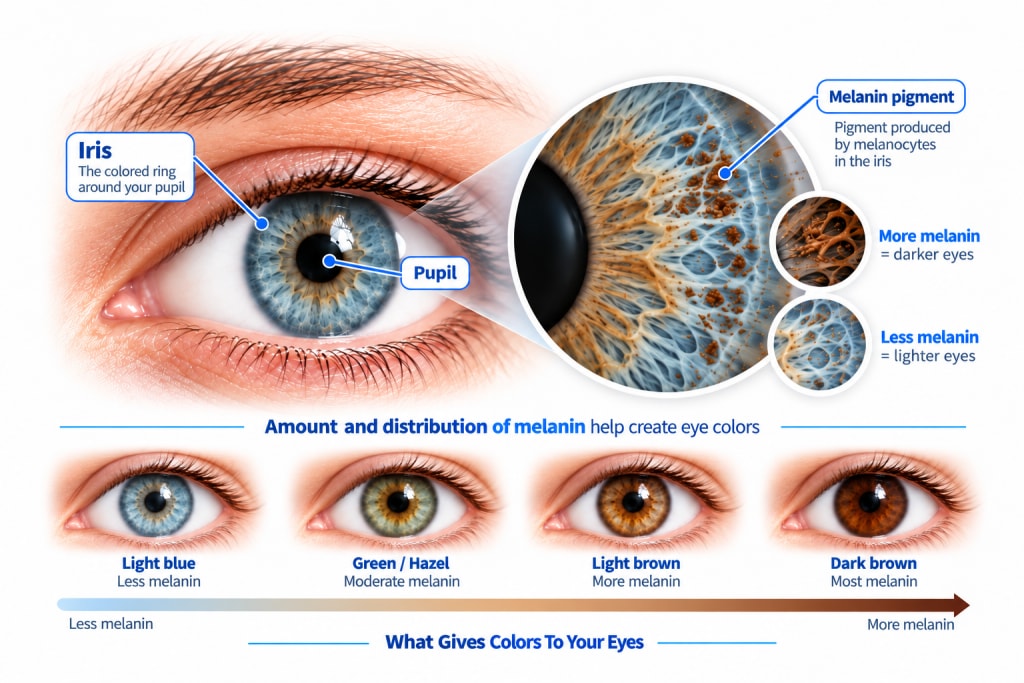
In general, brown eyes have more melanin in the front layers of the iris, while blue eyes have much less. You can see how these differences contribute to specific brown shades in our guide to the different shades of brown eyes. Genetics influences how melanin is produced, transported, and stored, which is why eye color and melanin are closely connected but cannot be explained by pigment alone.
For a closer look at the pupil, iris, and other structures involved in vision, see our eye anatomy 101 guide.
How Light Changes the Color You See
Light helps determine how iris pigmentation and structure become the color you actually see. Melanin absorbs light, so an iris with more pigment generally appears darker, while an iris with less pigment allows more light scattering within the stroma, the connective tissue that forms much of the front portion of the iris.
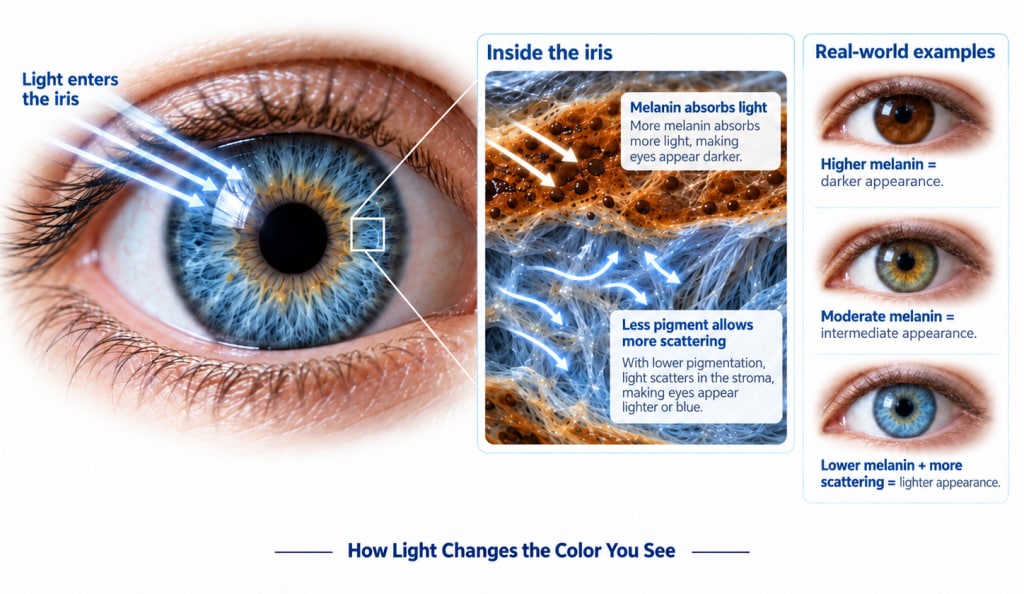
This is especially important for lighter eye colors. Blue eyes do not contain a blue iris pigment; their visible blue appearance results largely from low pigmentation combined with the way light interacts with iris tissue.
Want to see how iris pigmentation may relate to the way your eyes respond to light? Learn more about whether eye color impacts your vision.
Why Every Iris Looks Slightly Different
Two people can share the same general eye color and still have noticeably different irises. Pigment is not distributed identically from person to person, and natural structural features add patterns, texture, and contrast that make each iris visually distinctive.
Those differences can include:
- Uneven pigment distribution that creates lighter and darker areas within the same iris.
- Iris crypts, which are small depressions or openings in the surface stroma.
- Radial streaks and other patterns extending outward from the pupil.
- Rings near the pupil or around the outer portion of the iris.
- Small flecks or localized areas of contrasting pigmentation.
- Differences in the density and arrangement of iris tissue that affect how light is reflected and scattered.
Together, genetics, pigmentation, iris structure, and light create far more variation than a simple brown, blue, green, or hazel label can capture. These biological factors determine your natural iris appearance, while cosmetic contact lenses can only create a temporary change in how the eyes look.
How Common Are Different Eye Colors
Brown is the most common eye color worldwide, while lighter and mixed colors occur at very different rates across populations and geographic regions. Exact worldwide eye color percentages should be treated as estimates because researchers do not always classify gray, hazel, amber, and mixed colors the same way. Green eyes are consistently described as one of the least common major categories.
The Most Common Eye Color
Brown is the most common eye color worldwide. MedlinePlus identifies brown as the most frequent global iris color, while Cleveland Clinic estimates that more than half of the world’s population has brown eyes.
That broad global pattern does not mean brown occurs at the same rate everywhere. Eye color distribution differs substantially among populations because genetic ancestry and geographic history influence which pigmentation-related variants are more common.
The Rarest Eye Colors
Green eyes are among the least common of the major natural categories. Cleveland Clinic estimates that about 2% of people worldwide have green eyes, while the National Eye Institute also identifies green as a particularly uncommon color.
Gray eyes are also uncommon, but declaring gray universally rarer or more common than green can be misleading. Some datasets separate gray from blue, while others combine similar light-colored irises or use broader classification systems, making direct worldwide comparisons difficult.
Curious about how two less common eye colors compare? Learn how to distinguish hazel vs. green eyes by their dominant colors, patterns, and visible mixtures.
A useful global snapshot looks like this:
Note: These categories should not be read as a precise rarest-to-most-common ranking. Population, ancestry, classification criteria, and the way eye color is recorded can substantially change the percentages.
Why Eye Color Percentages Vary
There is no single worldwide eye color chart that every study uses. Even large datasets can produce different percentages depending on who was studied and how each iris was classified.
Several factors explain the variation:
- Different studies may combine or separate blue, gray, green, hazel, amber, and mixed irises differently.
- Regional samples can produce very different results because eye colors are not distributed evenly across populations.
- Mixed-color eyes may be classified as hazel, green, brown, or another category depending on the system being used.
- Self-reported eye color can differ from classifications made from standardized photographs or clinical observation.
A 2025 study illustrates the problem clearly. Using self-reported driver-license data from 31 U.S. states, researchers reported 53% brown/black, 23.7% blue, 10.3% hazel, 9% green, 0.7% gray, and 3.3% other; the underlying records were reported for 2016, so these figures describe that specific U.S. dataset rather than current worldwide prevalence.
That is why eye color rarity is best interpreted within a defined population and classification system rather than as one fixed global ranking.
How Eye Color Genetics Work
Eye color genetics are polygenic, meaning many genes contribute to the final result. OCA2 and HERC2 play major roles in iris pigmentation, but other genes also influence melanin production, processing, and distribution. That complexity is why parental eye color can suggest possible outcomes without predicting a child’s eye color with certainty. Genetics determines natural pigmentation, while daily coloured contact lenses can temporarily change the visible color without altering those inherited traits.
OCA2 and HERC2
OCA2 and HERC2 are two of the best-studied genes involved in eye color inheritance, and both are located on chromosome 15. OCA2 helps regulate pigmentation, while a region within HERC2 can affect how strongly OCA2 is expressed, influencing the amount of melanin produced in the iris.
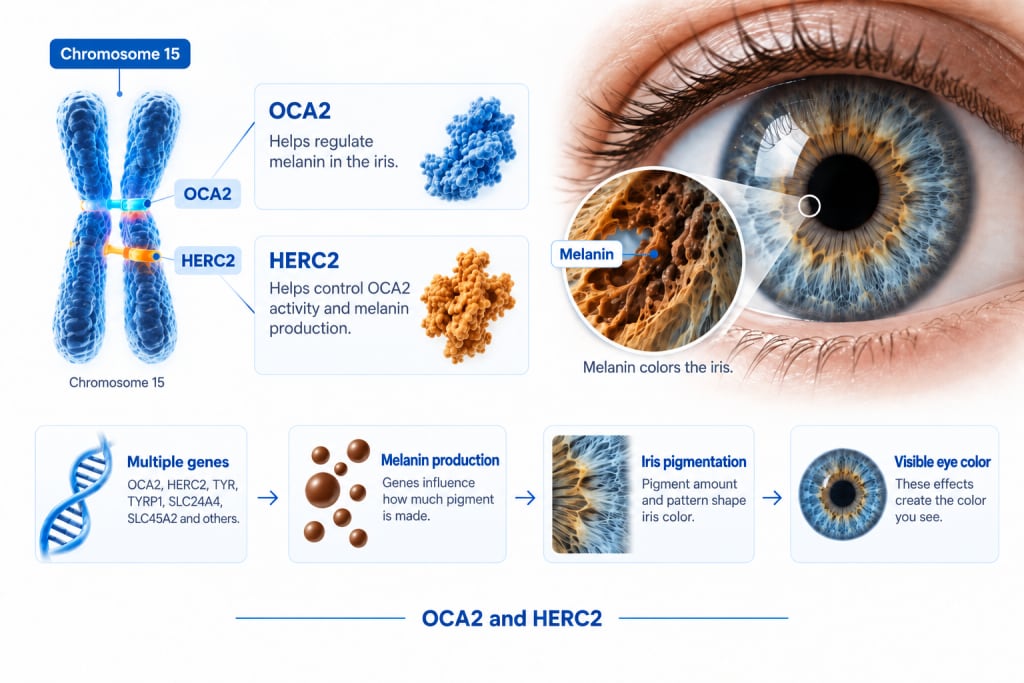
They are important, but they are not the whole story. Other genes, including TYR, TYRP1, SLC24A4, and SLC45A2, also contribute to pigmentation, helping explain why human eye color includes so many shades and mixed patterns rather than only a simple brown-versus-blue split.
Why Brown Dominant and Blue Recessive Is Too Simple
The familiar idea that brown eyes are simply “dominant” and blue eyes are simply “recessive” is an oversimplification. That classroom model treats eye color as if one gene controls the outcome, but real inheritance involves combinations of variants across multiple genes. This means a Punnett square based on one brown and one blue gene cannot reliably predict a child’s final iris color. The simple model can describe some family patterns, but it cannot account for the full range of brown, blue, green, gray, hazel, and other visible variations.
Why Children Can Have a Different Eye Color From Their Parents
A child inherits genetic variants from both parents, and the combination may produce an eye color that does not closely match either parent’s visible eye color. Parents can carry pigmentation-related variants that are not obvious from their own iris appearance, and those variants can combine differently in their children. That is why two parents with similar-looking eyes can have children with different shades, and siblings can also have noticeably different eye colors. For a deeper look at parental combinations, specific genes, and common inheritance questions, see our supporting guide to Eye Color Genetics and Family Traits.
How Eye Color Develops in Babies and Children
A baby’s eye color may change after birth as iris pigmentation develops, but not every baby starts with blue eyes and not every child’s eye color changes. Genetics sets the overall potential for pigmentation, while melanin development can make the iris appear darker or otherwise different during infancy and early childhood.
Why Some Babies' Eye Colors Change
Some babies are born with relatively little visible pigment in the front layers of the iris. As melanocytes continue producing melanin after birth, the iris may gradually become darker or shift in appearance. The amount and pattern of that pigmentation are largely directed by genetics, so changes vary from child to child. A lighter-looking newborn iris may become brown, hazel, green, or another shade, while other babies are born with darker eyes that change very little.
When Eye Color Becomes More Stable
Changes in baby eye color are often noticed during the first months of life, but there is no single age when every child’s eye color becomes final. Cleveland Clinic notes that changes can become noticeable from around 3 months of age and that, for most children, eye color becomes more stable during childhood, though some variation may continue for several years.
A simple developmental timeline is:
- Birth: Babies can be born with brown, blue, gray, or other visible iris colors.
- First months: Melanin development may begin making the iris look darker or different.
- Infancy and early childhood: Color may continue to shift as pigmentation develops.
- Later childhood: For most children, the overall color becomes increasingly stable.
How Parents Influence a Child's Eye Color
Parents strongly influence a child’s inherited eye color, but their visible eye colors are only part of the genetic picture. A child receives many pigmentation-related gene variants from both sides of the family, so the final result may resemble one parent, combine traits from both, or look different from either. For adults whose natural eye color is already established and who want a temporary cosmetic change, brown contact lenses are one color option that should still be prescribed and properly fitted.
This is also why the common claim that blue-eyed parents can produce only blue-eyed children is too simple.
Why Your Eye Color Can Look Different
Your eye color can appear lighter, darker, greener, grayer, or more golden even when the iris itself has not changed. Lighting, pupil size, camera settings, nearby colors, clothing, makeup, and visual contrast can all affect how you perceive the same iris. These temporary appearance shifts are far more common than true changes in iris pigmentation.
Lighting and Camera Conditions
Lighting can make your natural eye color look lighter, darker, warmer, or cooler because daylight, indoor bulbs, shadows, and the direction of light reveal different iris details and undertones. Camera exposure, white balance, and flash can further change how those colors appear in photos without altering your actual iris pigmentation. This is why blue eyes may look grayer or brighter and hazel eyes may appear greener or more golden, while light blue contact lenses can create a temporary blue effect when they match your prescription and are properly fitted.
Pupil Size and Visible Iris Area
Your pupil size can change how your iris looks without changing its actual pigment. When your pupil constricts in bright light or dilates in dim light, the surrounding iris tissue shifts, making rings, flecks, and color differences more or less noticeable. Emotions and other normal nervous-system responses can also affect pupil size, but they do not instantly change your natural eye color.
Clothing Makeup and Surrounding Colors
Clothing, makeup, hair color, and nearby backgrounds can influence how you perceive your eye color by creating visual contrast with tones already present in your iris. Warm colors may make cooler tones in blue eyes stand out, while greens or warm neutrals can emphasize different brown, green, or gold areas in hazel eyes. If your eyes look different under various colors or lighting but the underlying iris pattern stays the same, the change is usually perceptual rather than a true change in pigmentation.
Can Eye Color Change Over Time
Eye color changes can occur, but major changes after early childhood are less common than temporary shifts caused by lighting, pupil size, or surrounding colors. Aging, certain medications, injury, inflammation, and other changes affecting the eye may alter iris pigmentation or appearance.
Normal Changes With Age
Your eye color is most likely to change during infancy and early childhood while melanin and iris pigmentation are still developing. Once that process stabilizes, your general eye color usually remains fairly consistent throughout adulthood. Subtle changes can occur with age, but a dramatic shift from one major eye color to another is not considered a routine part of normal aging.
Changes Related to Medications or Eye Conditions
Certain medications and eye conditions can change your iris pigmentation or make one eye appear different from the other. Some glaucoma medications, as well as inflammation, bleeding, injury, and other eye problems, have been associated with acquired eye color changes. Because appearance alone cannot identify the cause, an eye care professional will consider when the change began, whether one or both eyes are affected, and whether you also have pain, redness, light sensitivity, or vision changes.
One Eye Changing Color
If only one of your eyes develops a new color change, it deserves more attention than a stable difference you have had for years. Injury, inflammation, disease, or other changes affecting the eye can sometimes cause one iris to become lighter, darker, or otherwise different from the other. Have any persistent or unexplained one-eye color change examined rather than trying to determine the cause from appearance alone.
Heterochromia and Mixed Eye Color Patterns
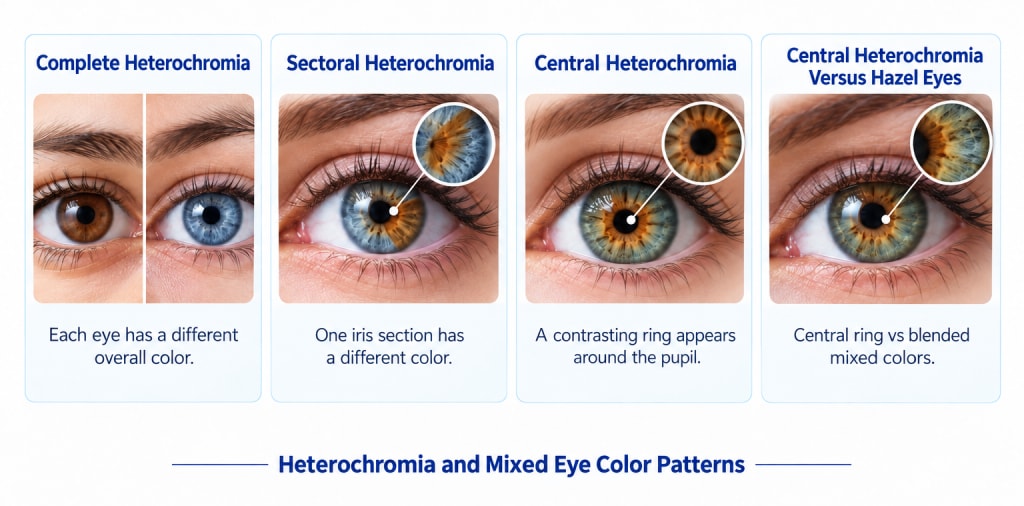
Heterochromia means there is a noticeable difference in iris pigmentation either between your two eyes or within one iris. It may be inherited or present from birth, while acquired heterochromia can develop after injury, disease, inflammation, or other changes affecting the eye. A new color difference should be evaluated, particularly when it appears suddenly or with other eye symptoms.
Complete Heterochromia
Complete heterochromia means one iris has a different overall color from the other. For example, one eye may appear brown while the other appears blue or green. A stable difference that has been present since birth or early life may simply reflect inherited pigmentation. A newly developed difference between the eyes has a different medical context and may need an eye examination.
Sectoral Heterochromia
Sectoral heterochromia occurs when one section of an iris has a noticeably different color from the rest. The different area may look like a wedge or patch extending through part of the iris rather than changing the eye’s entire color. This can create striking eye color combinations within a single eye while leaving the remaining iris relatively uniform.
Central Heterochromia
Central heterochromia describes a distinct difference in color around the pupil compared with the middle or outer portion of the iris. It may appear as a ring or central zone of brown, gold, amber, or another color surrounded by a contrasting outer iris. The important feature is the pattern: the color difference is concentrated around the pupil rather than spread evenly throughout the iris.
Central Heterochromia Versus Hazel Eyes
Central heterochromia describes a specific pigmentation pattern, while hazel eyes describe an overall mixed eye-color appearance. With central heterochromia, a clearly different inner ring or central zone surrounds the pupil; hazel eyes more broadly combine visible brown, green, and/or gold across the iris. If you simply prefer a mixed hazel appearance rather than having a natural pigmentation pattern, ColorBlends contacts can create a temporary cosmetic effect when prescribed for you.
Real irises do not always fit perfectly into color labels, so a mixed-looking eye may be difficult to classify from appearance alone. If the pattern is new rather than lifelong, especially if it affects only one eye, an optometrist or ophthalmologist can determine whether it represents normal variation or an acquired change.
Does Eye Color Affect Vision or Light Sensitivity
Your eye color does not determine whether you have good or bad vision. Iris pigmentation can affect how light behaves inside the eye, and severe pigment reduction such as albinism can cause significant light sensitivity, but normal eye-color differences should not be treated as a reliable measure of visual acuity, night vision, or overall eye health.
Does Eye Color Affect Vision
No. Your iris color does not determine whether you are nearsighted, farsighted, have astigmatism, or can achieve sharp visual acuity with the appropriate correction. A study of 853 adults found no significant difference in best-corrected visual acuity among light-blue, blue-gray, green-hazel, and brown iris groups, although some differences in intraocular straylight and contrast sensitivity were observed.
For a closer look at the relationship between iris pigmentation and visual function, see whether eye color impact your vision.
Does Eye Color Affect Light Sensitivity
Normal differences in iris pigmentation are not a reliable predictor of how sensitive you will be to bright light. In a study of 489 healthy adults, iris color did not significantly affect measured discomfort-glare thresholds, and more recent research has also reported no significant association between iris color and overall light-discomfort thresholds. Severe loss of ocular pigment is different. People with albinism can experience photophobia and glare sensitivity along with other vision-related effects because pigmentation and eye development are substantially altered.
Wondering whether blue eyes respond differently to bright conditions? Learn whether blue eyes are more sensitive to light and what research says about iris pigmentation, glare, and light discomfort.
Does Eye Color Affect Night Vision
No eye color should be described as having inherently better night vision. Research has found some pigmentation-related differences in intraocular light scatter and contrast under certain conditions, but those findings do not establish that blue eyes, brown eyes, or another color consistently sees better in the dark.
Individual night vision depends on multiple factors, including retinal function, pupil response, refractive correction, age, and eye health. Eye color alone is not a useful way to predict it.
Do Lighter Eyes Need Different Sun Protection
UV protection is important for every eye color, not only lighter eyes. The National Eye Institute recommends sunglasses that block 99% to 100% of both UVA and UVB radiation, including on cloudy days. If you wear contacts, UV blocking contact lenses may provide additional UV protection depending on the prescribed lens, but sunglasses still matter because contacts do not cover the entire eye or surrounding skin.
If you wear contacts, sunglasses still matter even when your lenses have UV-blocking properties because contact lenses do not cover the entire eye or surrounding skin.
When an Eye Color Change Needs an Eye Exam
A familiar eye color or lifelong iris pattern usually is not an emergency, but a new or rapid change should be checked, especially if it affects only one eye or occurs with pain, redness, injury, light sensitivity, discharge, or blurred vision. An optometrist or ophthalmologist can examine your iris and determine whether further testing is needed, and if you are cleared for contact lens wear, use only the Rx contacts prescribed for you.
Ask an eye care professional to check changes such as:
- A newly different color in one iris
- Unexplained darkening or lightening
- A new spot, ring, or pigmentation pattern
- An eye color change that begins after starting a medication
Certain glaucoma medications, including travoprost, can gradually darken iris pigmentation, and the change may be permanent, so discuss medication-related changes with your prescribing professional rather than stopping treatment on your own. Your eye exam may include a slit-lamp examination, which gives your optometrist or ophthalmologist a magnified view of the iris, pupil, cornea, and other structures at the front of your eye.
When Can You Change Your Eye Color Safely?
You can temporarily change or enhance your eye color with colored contact lenses when they are prescribed, properly fitted, and worn as directed. In the United States, all colored contacts, including decorative, costume, and plano lenses, require a valid prescription even if you do not need vision correction.
Colored contacts can create a subtle or noticeable change, and options such as discount colored contact lenses should match your prescription and be professionally fitted because poor fit or improper use can lead to corneal injury, infection, and vision problems. Decorative lenses are also regulated medical devices, so buy only from sellers that verify prescriptions and follow the wearing, cleaning, and replacement schedule prescribed for you; you can also learn whether colored contacts are safe before choosing them. Permanent eye color procedures, including cosmetic iris implants and keratopigmentation, are invasive and can carry risks such as inflammation, glaucoma, corneal damage, infection, light sensitivity, and reduced vision, while cosmetic iris implants used only to change eye color are not FDA-approved in the United States.
For a temporary change, properly prescribed and fitted colored contacts are the safer option to discuss with your eye care professional. Permanent cosmetic procedures should not be treated as equivalent alternatives to contact lenses.
What You Should Know About Your Eye Color
Your eye color reflects a combination of pigmentation, iris structure, genetics, and light, so broad labels such as brown, blue, or hazel tell only part of the story. Use the color-specific supporting guides to explore your natural shade, genetics, and common variations in more detail. Lighting and surrounding colors can change how an iris looks without changing its pigmentation, while a new unexplained change deserves more attention.
If you are interested only in a temporary cosmetic change after confirming that your eyes are healthy, types of contact lenses can help you explore the broader lens categories available for your prescription. Schedule an eye exam If one eye changes color unexpectedly or the change occurs with pain, redness, injury, light sensitivity, or altered vision
Your natural eye color can help you decide whether you want a subtle enhancement or a more noticeable color change, but any colored lens still needs the right prescription and fit. If colored lenses are part of your plan, browse our contact lenses that match your prescription and eye-care needs.
Learn More About Eye Colors
Get clear answers to common questions about eye color genetics, heterochromia, unusual eye colors, inheritance, and why your eyes can sometimes appear to change color.
Is central heterochromia the same as hazel eyes?
No. Central heterochromia describes a distinct ring or zone of color around the pupil that differs from the rest of the iris, while hazel eyes describe a more broadly mixed appearance that often includes brown, green, and gold. Real irises vary considerably, so some eyes may not fit perfectly into either label based on appearance alone.
Can two brown-eyed parents have a blue-eyed child?
Yes. Two brown-eyed parents can have a blue-eyed child because eye color inheritance involves multiple genes rather than one simple brown-dominant, blue-recessive pair. Variants in genes such as OCA2 and HERC2, along with several other pigmentation-related genes, can combine in ways that produce an eye color different from either parent's visible color.
Can two blue-eyed parents have a brown-eyed child?
Yes, although it is uncommon. The older one-gene model suggested that two blue-eyed parents could not have a brown-eyed child, but modern genetics shows that multiple genes contribute to iris pigmentation and can occasionally produce unexpected combinations. An exact probability cannot be determined reliably from the parents' visible eye colors alone.
Are black eyes a natural eye color?
What people describe as black eyes are usually extremely dark brown eyes, not a separate black iris color. In very dark brown irises, the boundary between the pupil and iris can be difficult to distinguish, especially under lower lighting. Brown, blue, green, gray, hazel, and amber are the six major categories commonly recognized by medical sources, so true black is not typically treated as a seventh standard natural eye color.
Are violet eyes a natural eye color?
Violet is not generally classified as one of the major natural eye colors. An iris may look violet under certain lighting conditions or when pigmentation is unusually low, but that appearance should not be interpreted as evidence of a distinct violet pigment. For example, very low ocular pigmentation in albinism can produce extremely pale blue or gray eyes and, in some cases, a pink or reddish appearance.
What is the difference between hazel and amber eyes?
Amber eyes usually have a more uniform golden, yellow-brown, or copper-toned appearance, while hazel eyes typically show a more varied mixture of brown, green, and gold. Hazel coloration does not have to contain equal amounts of each color, so individual irises can look quite different.
Can your eyes change color with your mood?
No. Your mood does not normally change the pigment in your iris instantly. Emotions can affect pupil size, and changes in pupil size, lighting, and contrast may make different areas of the iris more noticeable, creating the impression that your eye color has changed. A persistent or unexplained biological color change is different from these temporary appearance shifts.
Disclaimer: This content is for general informational purposes only and is not a substitute for professional advice, diagnosis, or treatment.
References
Is eye color determined by genetics? National Library of Medicine, MedlinePlus Genetics. https://medlineplus.gov/genetics/understanding/traits/eyecolor/. Date Accessed: October 8, 2026.
Genetics of Skin, Hair, and Eye Color in Human Pigmentation Disorders. Prashiela Manga and Stacie Loftus, Annals of Human Genetics. https://pubmed.ncbi.nlm.nih.gov/40605698/. Date Accessed: October 8, 2026.
Genome-wide association study in almost 195,000 individuals identifies 50 previously unidentified genetic loci for eye color. Simcoe et al., Science Advances / PubMed. https://pubmed.ncbi.nlm.nih.gov/33692100/. Date Accessed: October 8, 2026.
Colored and Decorative Contact Lenses A Prescription Is A Must. U.S. Food and Drug Administration. https://www.fda.gov/consumers/consumer-updates/colored-and-decorative-contact-lenses-prescription-must. Date Accessed: October 8, 2026.
Fuchs Heterochromic Iridocyclitis. EyeWiki, American Academy of Ophthalmology contributors. https://eyewiki.aao.org/Fuchs_Heterochromic_Iridocyclitis_and_Secondary_Glaucoma. Date Accessed: October 8, 2026.