
Take a look around any crowded room, and you’ll immediately notice just how many people are there with brown eyes. Up to 80% of people worldwide have brown irises, making it the most widespread eye color on Earth. In the U.S. alone, about 45% of the population boasts brown eyes, displaying an incredible variety of shades.
Being widespread is a far cry from being plain. Every pair of brown eyes features its own complex iris patterns, unique light reflections, and rich biological backstory.
10 Interesting Facts About Brown Eyes
Brown eyes have plenty of fascinating features and history. Here are 10 amazing facts that show there’s much more to brown eyes than meets the eye:

- Brown eyes have deep roots in human history.
Ancient DNA research shows that brown eyes ancestry was widespread among ancient populations. One major analysis about brown eyes evolution examined genetically predicted pigmentation in West Eurasia across the last 16,000 years and found brown eyes to be the modal eye color. A related Southern Arc project analyzed more than 1,300 ancient individuals, including 727 newly sequenced people spanning over 10,000 years. - Brown eyes can feature heterochromia.
Having brown eyes doesn’t mean your irises are strictly one solid shade. People with brown eyes can have partial heterochromia or central heterochromia. In one Stanford study of 192 newborns, partial heterochromia appeared in 0.5% of the infants, or 1 out of 192. - People with albinism may have brown eyes.
Albinism doesn’t automatically mean having pale blue or violet-looking eyes. Depending on the specific type, the body can produce enough melanin for the irises to take on a hazel or brown shade. For context, oculocutaneous albinism occurs in roughly 1 in 17,000 to 1 in 20,000 people worldwide. - Identical twins have completely different iris patterns.
While identical twins share nearly 100% of the same DNA, the fine, microscopic structures within their irises form randomly in the womb. Because of this, high-tech biometric iris scanners can easily distinguish one twin from the other. - Infrared light reveals hidden details in dark brown eyes.
Extremely dark irises can look uniform or near-black in standard photos, but near-infrared camera lenses slice right through that high melanin concentration to showcase intricate, wave-like textures underneath. - Your left and right irises aren’t identical either.
Just like your fingerprints, the structural patterns in your left and right eyes develop independently. Modern biometric systems can use each iris as a separate source of identifying information. - Brown eyes can develop visible iris freckles.
These tiny, harmless spots of extra melanin can pop up on the surface of your iris, just like freckles on your skin! A study involving 632 people found that 76.1% had at least one iris freckle. While they are usually completely benign, it’s always a good idea to have an eye doctor check out any new or changing spots during your routine exam. - DNA allows scientists to predict brown eye color.
In forensic science, geneticists can analyze specific DNA variants to accurately predict a person’s eye color. Because the genetic markers for brown eyes are so distinct, predicting brown or blue eyes is significantly easier for scientists than predicting complex, blended shades like hazel. The IrisPlex system, for example, uses just 6 highly informative genetic variants and has achieved greater than 94% average precision for brown and blue eyes in validation work, while intermediate colors remain harder to predict. - Brown eyes can still show the “red-eye” effect in photos.
That annoying red glow in flash photography isn’t caused by your iris color. It happens when the camera flash reflects off the blood vessels in the retina at the back of your eye. While high melanin levels absorb some extra light, brown eyes aren’t entirely immune to red-eye in dark rooms. - Brown is much easier to classify than intermediate colors.
Shades like green, hazel, amber, and gray often overlap visually, making them harder to categorize consistently. Because irises that are predominantly brown stand out so clearly, they are much simpler to identify and classify on official forms and medical records. In a recent 155-person study, brown-eye prediction reached 94.7% sensitivity and 89.5% overall accuracy, whereas intermediate eye color had 0% sensitivity with the method used.
What Makes Eyes Brown?
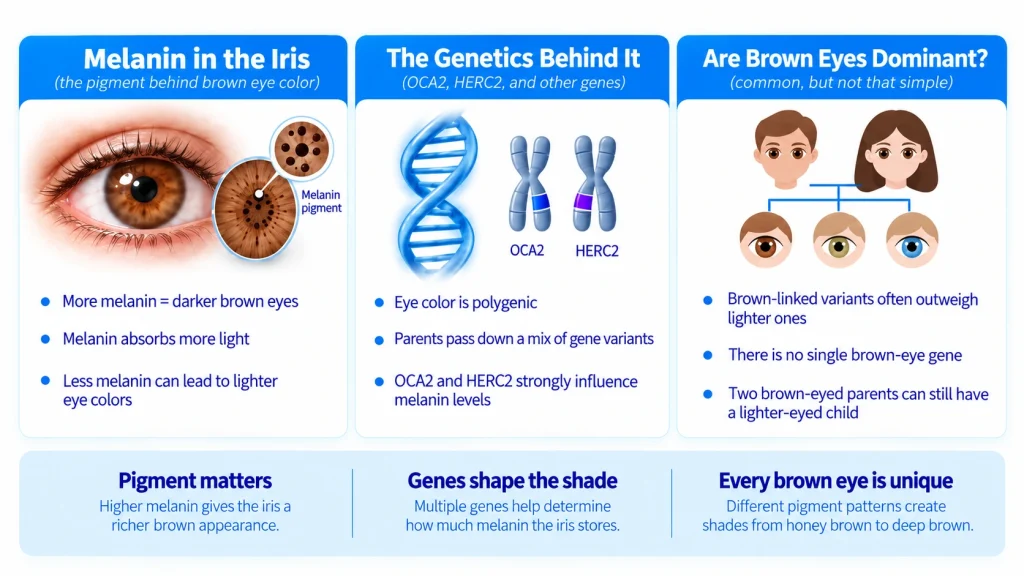
Why are brown eyes brown? It all comes down to a natural pigment called melanin, found inside the iris, the colorful ring surrounding your pupil. If you have brown eyes, it simply means your irises have a higher concentration of melanin compared to someone with blue, green, or gray eyes.
Your body doesn’t just decide how much pigment to make on a whim. Your eye color is the result of a complex genetic blend passed down from both of your parents.
How Melanin Creates Brown Eye Color
Melanin is nature’s built-in sunshade. It’s the exact same pigment that determines the color of your skin and hair. The melanin in brown eyes absorbs light entering the iris. The higher amount of melanin absorbs most light waves instead of scattering them. The eyes then take on a rich, brown hue. When there’s less melanin present, light scatters differently, creating lighter colors like blue, green, or hazel.
Often, the amount of melanin and how it is distributed in your iris determines your exact eye shade. A lighter dusting of pigment creates warm amber, hazel, or honey tones. Dense concentrations produce dark brown eyes that feel almost bottomless.
The Genetics Behind Brown Eyes
For a long time, high school biology taught us that brown eyes were strictly “dominant,” caused by dominant genes, and blue eyes were purely “recessive,” produced by recessive genes. Today, we know it’s a lot more interesting than that! Eye color is a polygenic trait, meaning multiple genes work together behind the scenes.
Two primary genes, OCA2 and HERC2, do most of the heavy lifting. These genes dictate how much melanin gets produced and stored in the iris. However, several other supporting genes tweak the final results.
Since so many genetic variables are at play, eye color inheritance isn’t a simple coin toss. It’s the reason two brown-eyed parents can surprise everyone with a blue-eyed baby, or why siblings end up with completely different shades of brown eyes.
Are Brown Eyes Dominant?
Brown eyes are often labeled as “dominant,” but what does that mean in actual practice? Genetic variants that boost melanin production tend to overshadow the variants tied to lighter shades. This is why brown eye color shows up so frequently in families where parents carry a mix of different eye color genes.
That said, labeling brown eyes as strictly dominant leaves out the cooler parts of the story. While it works as a convenient rule of thumb, it can’t predict a child’s exact eye color with 100% certainty. In fact, someone with rich brown eyes can easily carry hidden genetic variants for blue, green, or hazel eyes without those shades ever showing up in their own irises.
While brown eyes often take center stage in genetic inheritance, there isn’t a single “brown eye gene” calling all the shots. Thanks to the way melanin in brown eyes is regulated across multiple genes, eye color inheritance is much more of a dynamic spectrum than a rigid dominant-versus-recessive checklist.
What Are the Different Shades of Brown Eyes?
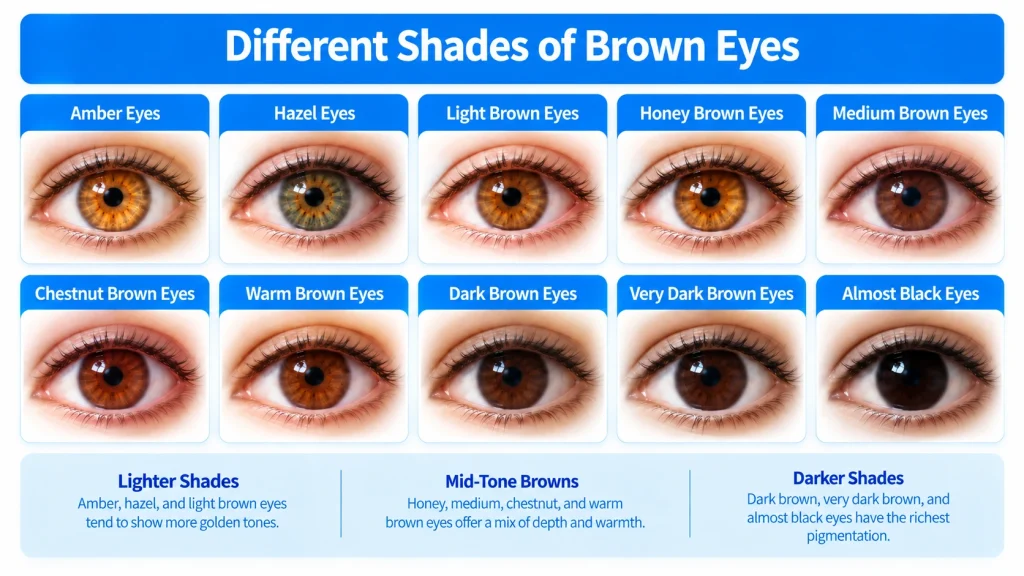
There’s no single uniform brown eyes appearance. Brown irises span a gorgeous spectrum, ranging from warm, sun-kissed honey to deep espresso. It all boils down to how much melanin is packed into the iris, how evenly that pigment is spread out, and the way ambient light bounces off the eye.
In fact, two people can both be listed as having “brown eyes” on their IDs while displaying completely distinct depths, golden undertones, and unique iris patterns up close.
Light Brown Eyes
Light brown eyes have just enough melanin to look distinctly brown while showing off beautiful golden, amber, or warm honey undertones. Step out into direct sunlight, and these radiant tones really pop, making the irises look significantly lighter and brighter than they do under soft indoor lighting.
Light brown eyes are sometimes confused with hazel or amber irises because of their bright, multidimensional look, especially if they feature subtle flecks of color. The key difference? The core color of the iris remains solidly brown rather than shifting into green or green-gold territory.
Medium Brown Eyes
Medium brown eyes hit that sweet spot, delivering a warm, balanced, and classic look. Depending on the lighting around you, this versatile shade can reveal hints of chestnut, rich caramel, or even reddish-gold undertones.
Up close, medium brown eyes are anything but plain. Because melanin isn’t always deposited in a perfectly smooth layer, you’ll notice intricate ring patterns, darker borders, or tiny golden flecks that give the iris incredible depth and complexity.
Dark Brown Eyes
Dark brown eyes pack a high concentration of melanin, giving the iris a strikingly rich, velvety color. In dimmer room light or when viewed from a distance, the iris and pupil blend together so seamlessly that the eyes can appear almost black.
Bring them into brighter light, and those deep hues instantly come to life. Sunlight unveils subtle mahogany swirls, warm chocolate tones, and intricate structural details that you might miss in low light. Even the darkest, most mysterious eyes are fundamentally a rich shade of brown rather than true black!
Brown Eyes vs. Hazel and Amber Eyes
Telling the difference between brown, hazel, and amber eyes can be tricky, especially under shifting light. The easiest trick to separate those pretty brown eyes is to look at the overall hue of the iris and see if it holds one primary shade or a blend of multiple colors.
- Brown Eyes
These irises are predominantly brown from edge to edge. They span everything from warm golden hues to deep chocolate tones, often featuring subtle ring patterns or flecks up close. - Hazel Eyes
Comparing brown eyes vs hazel eyes comes down to color blending. Hazel irises showcase an unmistakable mix of brown, green, and gold. Instead of a single solid color, different sections of the iris feature different shades. This is why hazel eyes seem to shift between green and brown, depending on your lighting, outfit, or pupil size. - Amber Eyes
Amber eyes feature a distinct, solid golden, yellow-brown, or coppery tone. They lack the multi-colored green-brown swirls found in hazel. While they can look a lot like light brown or hazel eyes at a quick glance, that intense, metallic copper or liquid-gold glow is what really sets amber apart.
Can Brown Eyes Change Color?
You might notice your irises looking lighter, darker, or shifting in warmth from one day to the next. What happened? Such changes can be attributed to two main causes.
Normal Changes in Appearance
You’re not imagining things when you look into the mirror and realize that your light brown eyes look darker than they were this morning. It’s completely normal to notice your brown eyes changing color in terms of appearance throughout the day. These temporary optical illusions are caused by factors that play tricks on your eye color.
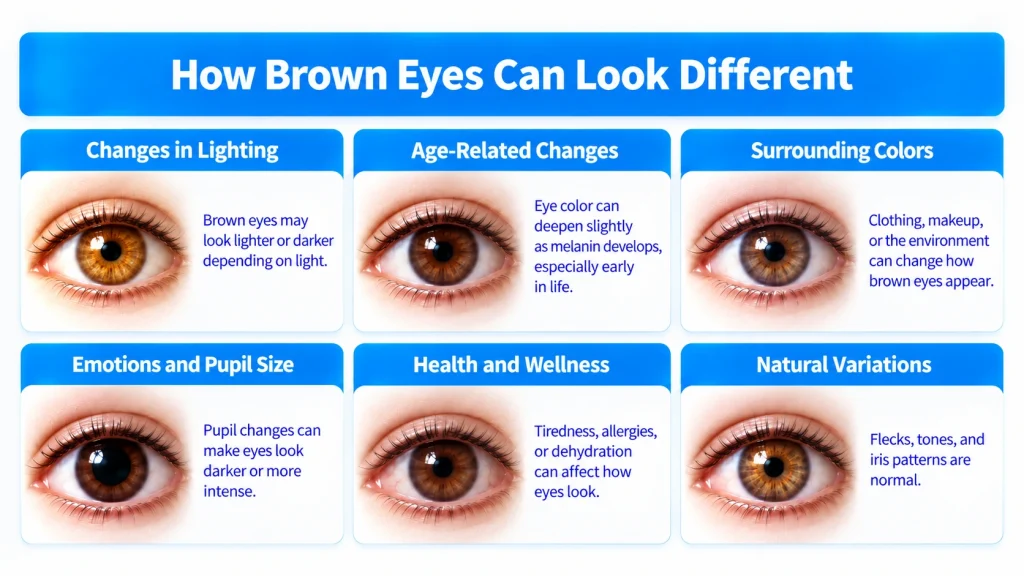
- Lighting: Direct sunlight penetrates deeper into the iris, revealing hidden golden, honey, or copper undertones that disappear indoors. Dim indoor lighting makes irises look much darker and richer.
- Pupil Size: When your pupils dilate in low light or contract in bright conditions, the visible area of your iris stretches or bunches up. This changes the density of the visible pigment, making your eyes look subtly darker or lighter.
- Surrounding Colors: The clothing, makeup, or hair color closest to your face creates color contrast. Wearing warm earth tones, gold jewelry, or deep blues can reflect light into your eyes, bringing out subtle flecks and making brown eyes look lighter.
- Photography and videography: Camera sensors, flash brightness, exposure levels, and white balance settings dramatically affect how brown eyes translate in photos and videos.
- Mood and Emotion: Strong emotions, like excitement, stress, sadness, or affection, cause your body to release hormones that dilate your pupils and increase blood flow to the eyes. They temporarily make irises appear more vivid or glassy.
- Hydration and Fatigue: When you’re dehydrated or exhausted, slight changes in your eye’s tear film can alter how light refracts off the surface of the iris.
Actual Changes in Eye Color
While daily shifts are just optical illusions, genuine biological changes do happen. Most notably, infants often experience eye color shifts as melanin levels gradually build up during early childhood.
But what about adults? Can brown eyes turn green or lighten out of nowhere? In adulthood, a true, lasting shift in iris color is rare and usually points to something happening beneath the surface.
Certain prescription eye drops, trauma to the eye, chronic inflammation, or specific medical conditions can alter the melanin inside the iris. If you ever notice a sudden color shift, especially if it only affects one eye or comes with vision changes, pain, or redness, have an optometrist or ophthalmologist check it out right away.
Does Having Brown Eyes Affect Eye Health?
Research shows that iris pigmentation is tied to certain vision traits, but having brown eyes doesn’t automatically mean you get a free pass on vision issues. Or, conversely, that you’re at higher risk. Factors such as age, family genetics, UV exposure, and general lifestyle choices play a massive role in overall brown eyes eye health.
While the extra melanin offers a built-in layer of shade, it doesn’t replace the need for healthy habits, proper UV protection, and routine eye exams.
Brown Eyes and Light Sensitivity
Are brown eyes sensitive to light? The short answer is: yes, but brown eyes light sensitivity is generally less so than lighter-colored eyes. Thanks to higher melanin levels, brown eyes absorb incoming rays and block stray light from scattering inside the eye. Due to this natural shielding, people with darker irises often experience less discomfort when stepping into bright sunlight.
However, having dark irises doesn’t make you immune to harsh glare. Severe brown eyes light sensitivity (photophobia) can still be triggered regardless of your pigment levels by factors such as:
- Dry Eye Syndrome
A lack of proper lubrication irritates the surface of the eye, making bright light uncomfortable. - Migraines and Headaches
Neurological triggers can temporarily heighten sensitivity to sunlight and bright indoor bulbs. - Eye Fatigue and Strain
Protect your eyes from excessive screen time. Prolonged screen time or uncorrected vision issues can leave eyes overworked and light-averse. - Certain Medications
Prescription drugs, including some antihistamines, acne treatments, and blood pressure medications, can cause photosensitivity as a side effect. - Eye Injuries and Conditions
Corneal abrasions, inflammation, or infections increase sensitivity to light, making UV protection even more crucial.
That’s why wearing 100% UV-blocking sunglasses remains essential for protecting brown eyes whenever you’re outdoors.
Brown Eyes and Eye Conditions
Researchers studying brown eyes health have spotted some interesting statistical links between darker irises and specific conditions. Keep in mind that these patterns represent broad population trends, not a personal guarantee for your individual eyes.
- Cataracts: Some medical studies have pointed to a slightly higher rate of age-related cataracts in people with dark brown eyes. Overall risk, however, is far more heavily driven by lifetime UV exposure, smoking, age, and medical conditions.
- Uveal Melanoma: Lighter eyes statistically have a higher risk of uveal melanoma, a rare cancer that forms inside the eye. Brown eyes carry a lower associated risk thanks to melanin’s protective qualities, though it doesn’t provide complete immunity.
- Age-Related Macular Degeneration (AMD): Researchers have long investigated whether iris color influences macular degeneration risk, but current evidence shows no consistent connection. Your eye color alone isn’t a reliable predictor for this condition.
No matter what shade of brown your irises are, booking regular comprehensive eye exams is the best way to catch vision changes early and keep your eyes healthy for life.
How to Keep Brown Eyes Healthy
Building a few good habits into your daily routine protects your vision, reduces irritation, and helps your eye doctor spot subtle changes long before they turn into bigger issues.
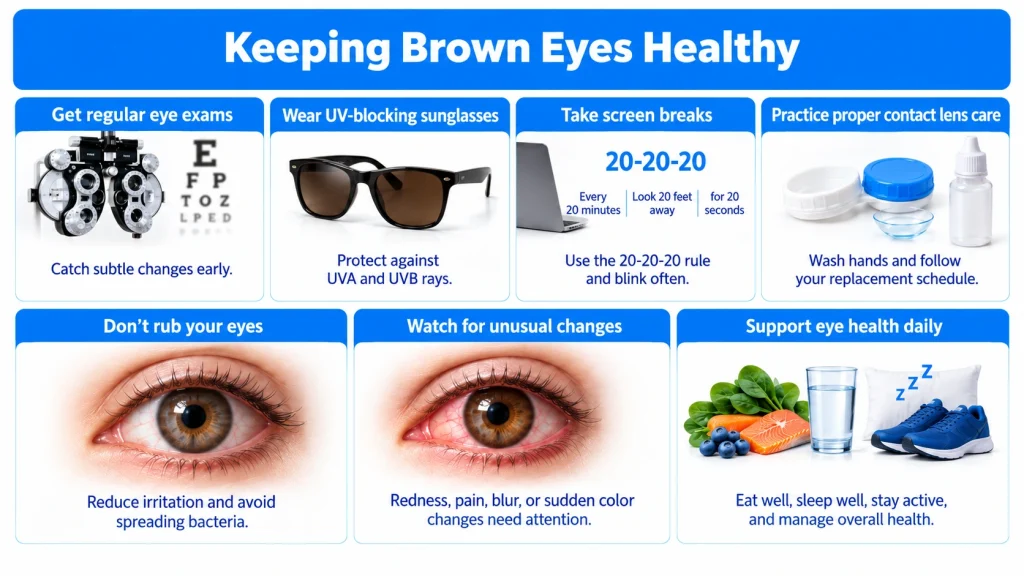
- Schedule regular eye exams.
Comprehensive eye exams can catch early vision shifts and eye conditions that don’t cause obvious symptoms right away. Stick to the checkup timeline recommended by your eye doctor based on your age, prescription, and overall health. - Protect your eyes from UV rays.
While the extra melanin in brown eyes offers a natural layer of light absorption, it doesn’t make you immune to UV damage. Always wear sunglasses that block 100% of UVA and UVB rays when spending extended time outdoors. - Give your eyes breaks from digital screens.
Staring at phones, tablets, and computers for hours leads to eye strain, fatigue, and dryness. Practice the 20-20-20 rule. Look at something 20 feet away for 20 seconds every 20 minutes. Blink frequently to keep your eyes refreshed. - Follow proper contact lens care.
Always wash and thoroughly dry your hands before touching your contacts, and strictly follow your lens replacement schedule. Never sleep, swim, or shower in contact lenses unless your eye care professional explicitly gives you the green light. - Avoid rubbing your eyes.
Rubbing can scratch the delicate surface of your cornea and transfer unwanted bacteria from your hands. If your eyes feel itchy or dry, use lubricating eye drops or address the root cause rather than rubbing for quick relief. - Pay attention to unusual changes.
Reach out to an eye care specialist right away if you notice sudden color shifts, persistent redness, pain, heightened light sensitivity, or blurry vision. These warning signs may signal an underlying issue that needs prompt treatment. - Support eye health with healthy daily habits.
Long-term vision protection starts from the inside out. A nutrient-dense diet rich in antioxidants and eye-friendly vitamins, routine physical activity, quality sleep, and managing health conditions like diabetes and high blood pressure all help keep your eyes crystal clear.
Can You Change the Appearance of Brown Eyes With Colored Contacts?
Yes. Premium or cheap contact lenses are an easy way to either enhance your natural brown shade or try out a completely new look. Some brown contact lenses for brown eyes simply add subtle warmth or a crisp outer border, while others can transform deep brown eyes into striking shades of green, gray, blue, or hazel.
Colored contact lenses work by placing a micro-printed tint over the colored portion of your iris. Here’s how different styles interact with brown eyes:
- Enhancement tints add subtle depth. These semi-transparent lenses blend with your natural eye color. They’re the go-to lenses if you want to rich-up your natural brown shade, add golden flecks, or define the outer edges.
- Opaque lenses deliver high-impact color. Heavily pigmented designs block out most of the natural brown underneath, allowing lighter colors like baby blue, emerald green, or cool gray to show up vividly.
- Your natural iris shade influences the effect. The exact same contact lens can look noticeably different on two people. Your underlying brown pigment shines through slightly, meaning light honey brown eyes and deep espresso eyes will yield unique shades.
- Light brown eyes blend effortlessly. If your irises are on the lighter side, softer tones like honey, olive green, warm caramel, or hazel contact lenses will seamlessly merge with your natural color for a hyper-realistic finish.
- Dark brown eyes need stronger coverage. Deeply pigmented eyes require high-opacity brown contact lenses to prevent the dark background from muting the new color.
- Multi-tonal patterns create a more natural look. High-quality lenses feature limbal rings (a dark outer border) and multi-layered color specks that mimic the natural, complex depth of a real human iris.
- Lighting changes the lens effect. Just like natural eyes, colored contacts react to your environment. A shade that looks deep and subtle indoors will appear much brighter and more intense out in direct sunlight.
The U.S. Food and Drug Administration considers all kinds of contact lenses to be medical devices. You will need a valid prescription from a duly licensed eye care specialist to purchase colored lenses.
What Do Brown Eyes Symbolize
Brown eyes have carried rich symbolic meanings across literature, art, and popular culture throughout history.

- Classic Natural Beauty: From warm honey to deep espresso, brown eyes symbolize an understated, timeless beauty that shines through intricate iris patterns rather than flashy bright pigments.
- Warmth and Approachability: Thanks to their rich, golden, and chocolate tones, brown eyes are frequently associated with comfort and welcoming energy. Writers and artists often give characters brown eyes to immediately signal kindness or familiarity.
- Stability and Groundedness: Because brown is the primary color of soil, wood, and stone, brown eyes are symbolically tied to dependability, steadiness, and being down-to-earth.
- Strength and Resilience: Deep, dark brown irises are often used in visual storytelling to convey inner strength, endurance, and quiet determination.
- Mystery and Depth: Very dark brown eyes can appear almost black under soft lighting, leading filmmakers and authors to use them as symbols for intrigue, intensity, and deep emotional complexity.
- Connection to Nature: As the most common earth tone in nature, brown eyes naturally evoke imagery of forests, fallen leaves, and natural balance, giving them an organic, rooted symbolism.
Brown Eyes Are Anything but Ordinary
Brown eyes might be the most common eye color on the planet, yet they’re anything but ordinary. What makes brown eyes unique? Well, every single pair of brown eyes boasts its own totally inimitable signature look. There’s so much to love about the science and story behind your gaze. The timeless symbolism surrounding brown eyes continues to inspire writers, artists, and readers around the world.
Disclaimer: This content is for general informational purposes only and is not a substitute for professional advice, diagnosis, or treatment.
References
Genetics of Human Iris Colour and Patterns. Sturm RA, Duffy DL. Current Topics in Developmental Biology. https://pubmed.ncbi.nlm.nih.gov/19619260/ 2009. Date Accessed: September 18, 2026.
Three Genome-wide Association Studies and a Linkage Analysis Identify HERC2 as a Human Iris Color Gene. Sturm RA, Larsson M. American Journal of Human Genetics. https://pubmed.ncbi.nlm.nih.gov/18252221/ February-2008. Date Accessed: September 18, 2026.
Iris Colour and the Risk of Developing Uveal Melanoma. Houtzagers LE, Wierenga APAW, Ruys AAM, Luyten GPM, Jager MJJ. International Journal of Molecular Sciences. https://pubmed.ncbi.nlm.nih.gov/32998469/ September-28-2020. Date Accessed: September 18, 2026.
Epigenetic Randomness, Complexity and Singularity of Human Iris Patterns. Daugman J. Proceedings of the Royal Society B: Biological Sciences. https://pubmed.ncbi.nlm.nih.gov/11506688/ September-2001. Date Accessed: September 18, 2026.
Iris Color and Cataract: The Blue Mountains Eye Study. Mitchell P, et al. American Journal of Ophthalmology. https://pubmed.ncbi.nlm.nih.gov/11004303/ October-2000. Date Accessed: September 18, 2026.