Your newborn’s eyes may look blue-gray, brown, or somewhere in between, and the shade you see today may not be the one you notice a few months from now. In fact, a Stanford study of 192 healthy full-term newborns found that 63% had brown eyes at birth while only 20.8% had blue eyes, showing that newborn eye color varies much more than the familiar “baby blues” stereotype suggests. If you’re wondering when babies’ eyes change color, changes can become noticeable during the first several months as pigmentation in the iris continues to develop, unlike the temporary appearance changes adults can get with contact lenses.
Babies’ eyes can begin changing color within the first few months of life, with many noticeable changes occurring during the first year. By about 9 months, your baby’s eyes may be close to their long-term color, although slight changes can still happen later. Not every baby experiences a noticeable eye color change; some are born with brown eyes that remain relatively stable, while blue or gray eyes may show more visible changes as pigmentation develops.
When Do Babies’ Eyes Change Color by Age?
There is no single month when every baby’s eye color changes or becomes permanent. A typical baby eye color change timeline stretches across the first year, with changes often becoming easier to notice between about 3 and 9 months and the overall shade becoming more stable toward the end of the first year. For adults, daily coloured contact lenses can provide a temporary change in eye color without affecting natural iris pigmentation.
Here is a general look at baby eye color changes by month. Think of these ages as broad developmental windows rather than deadlines your baby has to follow.
| Age | What’s Happening | What You Notice |
|---|---|---|
| Birth | Newborn eye color already varies from baby to baby | Eyes may appear brown, blue, gray, green-hazel, or difficult to classify |
| First 3 Months | Iris pigmentation may continue developing | The color may stay similar or begin changing subtly |
| 3 to 6 Months | Changes may become easier to notice | Lighter eyes may deepen or begin showing warmer tones |
| 6 to 9 Months | Pigmentation may continue becoming more established | Your baby’s likely long-term eye color may become clearer |
| 9 to 12 Months | The overall shade is often becoming more stable | Major changes may slow, although smaller shifts can still occur |
| After Age 1 | Some children continue to have subtle color changes | Slight darkening or changes in shade can continue beyond the first birthday |
The American Academy of Ophthalmology notes that a baby’s eyes are probably near their final color at about 9 months, while Cleveland Clinic reports that some children can continue developing their final shade for longer. For a broader look at developmental changes during the same period, see how your baby’s vision develops from birth to 1 year.
Note: Six, nine, and 12 months are useful reference points, not hard deadlines. Your baby’s final eye color depends largely on genetics and iris pigmentation, so the timing, amount, and visibility of any change can differ from one child to another.
What Determines a Baby’s Eye Color?
Your baby eye color is determined mainly by the genes they inherit and how much pigment develops in the iris, the colored part of the eye. It is more complex than the familiar idea that brown simply “beats” blue, because several genes work together to influence the final shade.
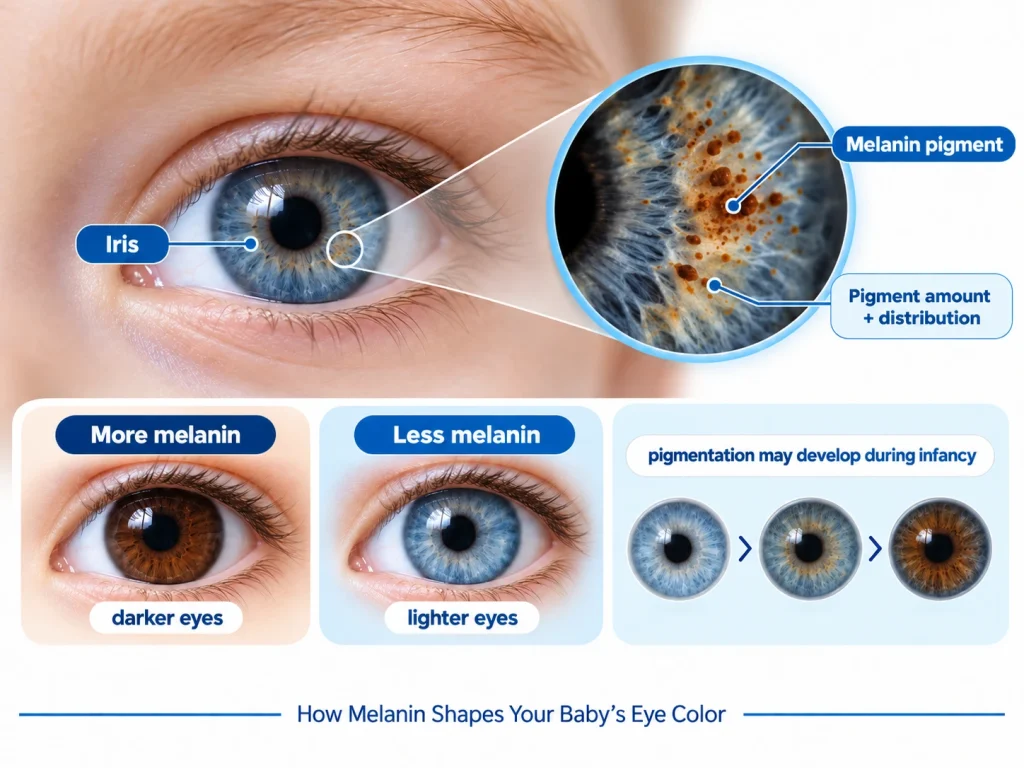
How Melanin Shapes Your Baby’s Eye Color
Melanin is the pigment that gives color to your baby’s eyes, skin, and hair, and the amount and distribution of melanin in the iris help determine how light or dark the eyes appear. Brown eyes generally contain more melanin in the front layers of the iris, while blue eyes contain much less, with green, hazel, and other shades falling along a broader spectrum. As pigmentation develops during infancy, some lighter eyes may gradually darken while others stay light.
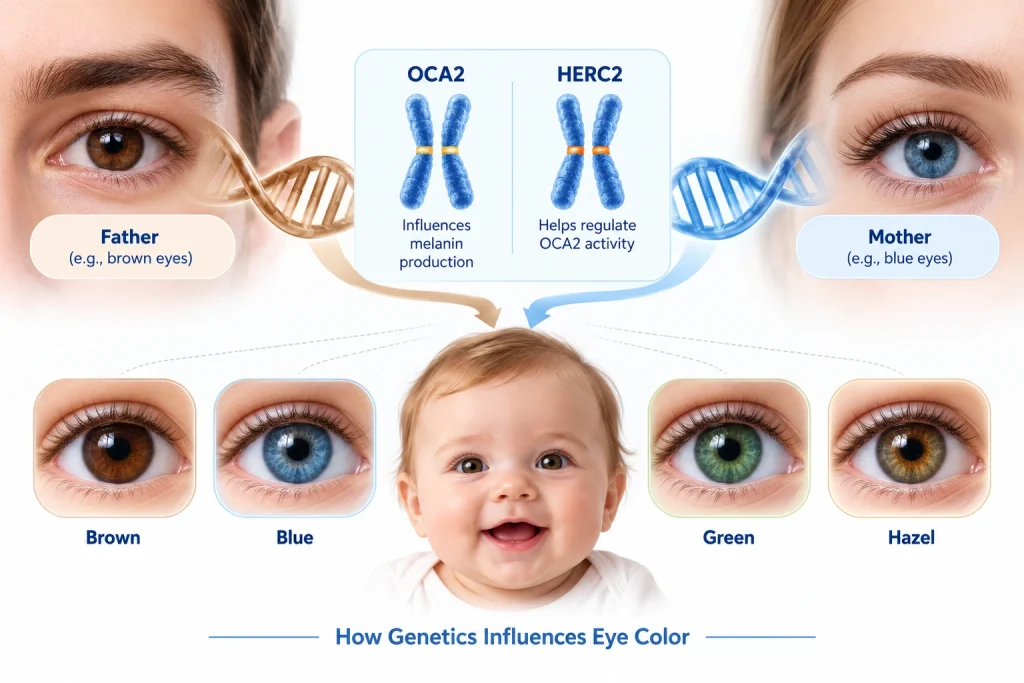
How Genetics Influences Eye Color
Your baby inherits genetic variants from both biological parents, which is why baby eye color genetics cannot be reduced to one dominant brown gene and one recessive blue gene. OCA2 and HERC2 are two of the genes with major roles in regulating iris pigmentation, but several other genes also contribute to the range of possible colors. This more complex pattern of eye color inheritance helps explain why your baby’s eyes may differ from either parent’s and why siblings can have different eye colors. Parent and family eye colors can offer clues, but they cannot predict your baby’s final color with certainty.
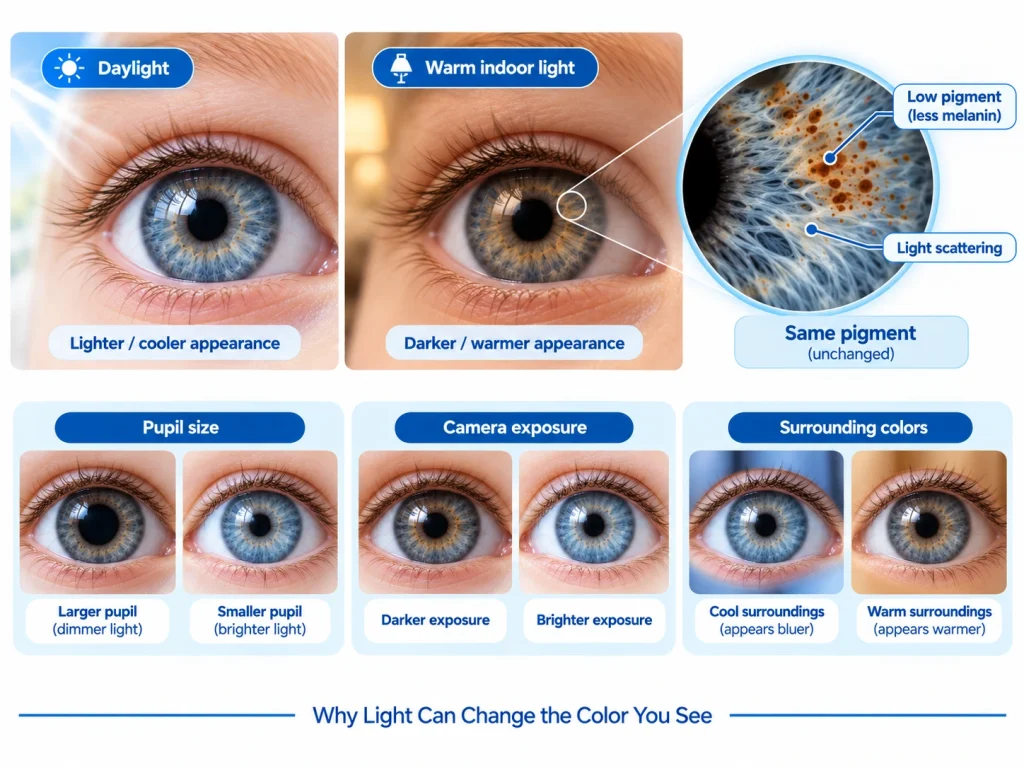
Why Light Can Change the Color You See
Light can make your baby’s eyes look different without actually changing the pigment in the iris. Blue eyes contain little pigment in the front layer of the iris, so their appearance depends partly on how light scatters, while lighting, pupil size, camera exposure, and surrounding colors can make blue, gray, green, or hazel tones look more or less noticeable. That is why the same eye color may look lighter near a window and darker or warmer indoors. Normal light exposure is not a way to choose or control your baby’s final eye color, so there is no reason to deliberately expose your baby’s eyes to extra sunlight to influence the result.
Curious why brown eyes generally contain more melanin than lighter eye colors? Read these facts about brown eyes to see how melanin and genetics contribute to their color.
Are All Babies Born With Blue Eyes?
No, not all babies are born with blue eyes. Newborns can have brown, blue, gray, green-hazel, or an eye color that is not easy to classify, depending largely on their inherited genetics and the amount of pigment already present in the iris at birth,, rather than the temporary blue appearance adults can create with light blue contact lenses. Some babies are born with brown eyes that remain relatively stable, while lighter-colored eyes may become darker as iris pigmentation develops.
A Stanford-led Newborn Eye Screening Test study of 192 healthy, full-term newborns found that brown was actually the most common iris color in that group. Researchers classified 63.0% of the newborns as brown-eyed, compared with 20.8% with blue eyes, showing why the idea that every newborn starts with blue eyes is a myth. The study also included green/hazel, indeterminate, and partially heterochromic eyes.
The study’s newborn eye-color breakdown was:
| Iris Color in NEST Study | Percentage |
|---|---|
| Brown | 63.0% |
| Blue | 20.8% |
| Green/Hazel | 5.7% |
| Indeterminate | 9.9% |
| Partial Heterochromia | 0.5% |
Note: These figures represent the 192 healthy, full-term newborns included in the NEST study and should not be treated as worldwide newborn eye-color percentages. Ancestry, study population, and how iris colors are classified can affect the distribution.
When Do Babies’ Eyes Stop Changing Color?
Many babies have an eye color close to their long-term shade by about 9 to 12 months although there is no exact age when every baby’s eyes stop changing. By about 9 months your baby’s eyes may be near their final color while subtle changes can still continue later. Research from the NEST follow-up also found that brown eyes were especially stable, unlike the temporary shade enhancement adults can get from brown contact lenses.
These changes are usually gradual and your baby’s final eye color often becomes clearer during the first year of life. Smaller shifts in shade can continue beyond that point as part of normal newborn eye color development. A sudden one-sided change or an eye that looks cloudy red or painful should be discussed with your pediatrician or an eye care professional.
Once your baby’s eye color becomes more stable, does that shade affect how well they see? Read about whether eye color impacts vision and how iris pigmentation relates to light and visual function.
Can You Predict Your Baby’s Final Eye Color?
Not with certainty. Your eye colors and those of other biological relatives can offer clues about your baby’s final eye color, but visible family traits do not reveal every genetic variant your baby can inherit. Eye color is influenced by multiple genes, including OCA2 and HERC2, along with several others that affect how much melanin develops in the iris.
Why Parent Eye Colors Are Clues Not Guarantees
Your baby receives pigmentation-related genetic variants from both biological parents, and those combinations can produce an eye color that does not exactly match either parent. This is why two brown-eyed parents can have a blue-eyed child and why siblings with the same parents may have different eye colors. A broader family history can make baby eye color prediction more interesting, but it still cannot tell you with certainty what color your baby’s eyes will become.
Why Simple Eye Color Calculators Have Limits
A baby eye color calculator can be fun for making a guess, but it should not be treated as a reliable genetic prediction. Many calculators still rely on the older idea that one brown-eye gene is dominant and one blue-eye gene is recessive, while modern genetics shows that eye color is a polygenic trait influenced by multiple genes.
That means a chart based only on whether you and the other biological parent have brown, blue, green, or hazel eyes leaves out much of the genetic picture. Your baby’s changing iris over the first months of life will usually tell you more than a simple online predictor.
Want to compare the different natural colors your baby’s eyes may develop into? See our guide to eye colors and genetics for a closer look at brown, blue, hazel, green, gray, and amber eyes.
Why Does Your Baby’s Eye Color Look Different in Photos or Light?
Your baby’s eye color can look bluer, grayer, greener, lighter, or darker from one photo to another even when the iris pigment has not changed, just as ColorBlends contacts can temporarily alter an adult wearer’s visible eye color without changing the natural iris pigment. Daylight, indoor lighting, pupil size, surrounding colors, and the direction of light can all affect how the iris appears. Camera exposure, white balance, and flash can add even more variation. These appearance changes can happen instantly while true baby eye color change from developing pigmentation is usually gradual.
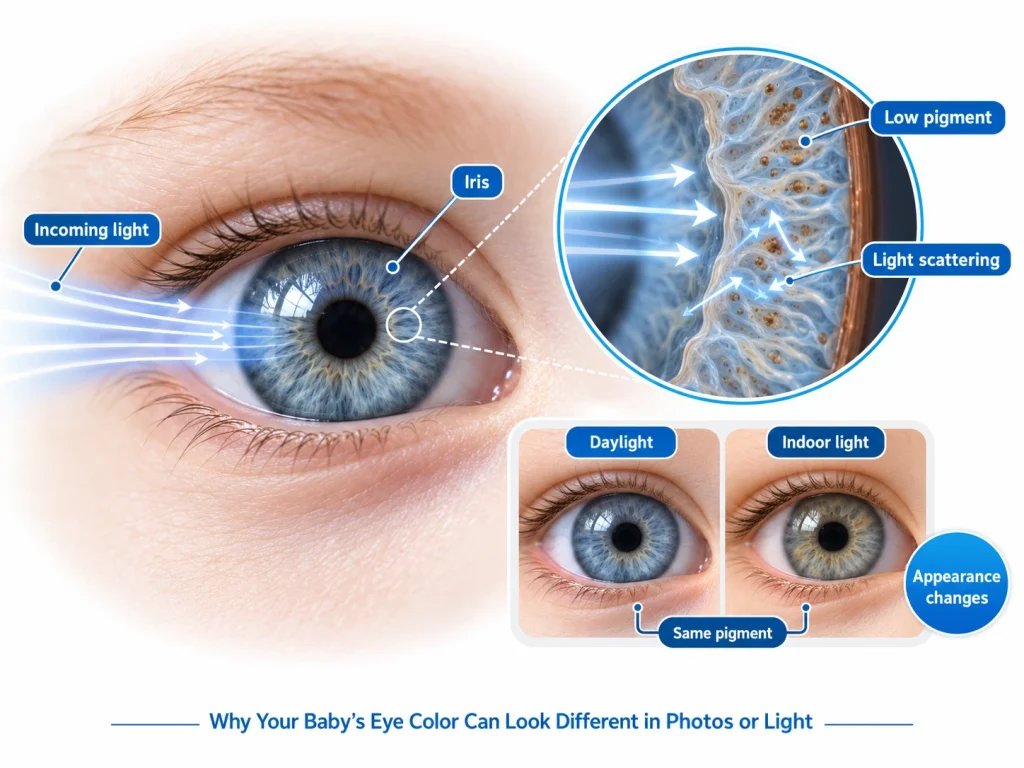
If you want to compare baby eye color change photos over time, use similar indirect natural daylight and a similar camera angle. Keeping conditions consistent can make gradual changes easier to notice without mistaking lighting effects for a real pigment change. Avoid deliberately exposing your baby’s eyes to bright sunlight just to check the color. A repeated white, yellow, or black pupil reflection should be shown to your child’s pediatrician or a pediatric ophthalmologist because it can sometimes signal an eye problem.
Wondering why blue eyes can respond differently to changing light and appear brighter in some conditions? Read whether blue eyes are more sensitive to light and how lower iris pigmentation affects light interaction.
What If Your Baby Has Two Different Eye Colors
If your baby has two different-colored eyes or more than one distinct color within the same iris, the difference is called heterochromia. It can be present from birth and may simply reflect a harmless variation in how pigmentation developed. Heterochromia can also be linked to genetic changes or differences in eye development. Because there are several possible causes, mention a noticeable color difference to your baby’s pediatrician or eye care professional.
A stable difference that has been present since birth is different from a new or progressive newborn eye color change affecting only one eye. If one eye suddenly becomes lighter or darker while the other stays the same, it deserves closer attention. Changes that occur with cloudiness, redness, swelling, pain, or another unusual eye symptom should also be evaluated. Avoid trying to determine the cause from appearance or photographs alone.
When Should You Call a Doctor About Eye Color Changes?
Gradual changes in both of your baby’s irises during infancy are usually part of normal newborn eye color development. A sudden, one-sided, cloudy, or otherwise unusual eye color change is different and should be discussed with your child’s pediatrician, pediatric ophthalmologist, or another qualified eye care professional rather than treated as an appearance issue like an adult might address with Rx contacts.
Contact a healthcare professional if you notice:
- One eye suddenly becoming lighter or darker while the other stays the same
- A new or progressively increasing difference between the two irises
- A white, yellow, or unusually dark pupil reflection that appears repeatedly in flash photographs
- Cloudiness affecting the pupil, cornea, or front of the eye
- Redness, swelling, eye pain, persistent tearing, strong light sensitivity, or an eye injury
- One eye consistently turning inward or outward
- Difficulty focusing on or tracking moving objects as your baby’s vision develops
By about 3 months, a baby’s eyes should generally work together to focus on and track objects, according to the American Academy of Ophthalmology. If you notice persistent difficulty with focusing, tracking, or eye alignment, read about other common eye problems in children and bring the concern to your pediatrician.
What You Should Know About Baby Eye Color?
Your baby’s eye color can begin changing during the first few months, with the long-term shade often becoming much clearer during the first year of life. Genetics and the amount of melanin in the iris help determine whether the eyes remain light or gradually darken, and some babies experience little noticeable change at all. Give normal baby eye color development time rather than relying on a single photograph or an online predictor to determine the final shade. If one eye changes unexpectedly, the pupil looks white or cloudy, or another concerning eye symptom appears, contact your child’s pediatrician or eye care professional.
Curious how a different eye color might look on you while your baby’s natural eye color continues to develop? Explore our color disposable contact lenses for a temporary eye color change with lenses prescribed and properly fitted for your eyes.
Learn More About Baby Eye Color Changes
Get answers to common questions about baby eye color, genetics, pigmentation, development, and changes during infancy.
Can a baby’s brown eyes turn blue?
A baby's brown eyes turning blue would be unusual as part of normal baby eye color development. Brown irises tend to be relatively stable, and a follow-up of the Newborn Eye Screening Test found that 94% of children classified as brown-eyed remained brown, while blue eyes changed more often. If a previously brown iris appears to become noticeably lighter, especially in only one eye or as a persistent change, have your child evaluated by a pediatrician or eye care professional rather than assuming it is normal pigmentation.
Will my baby’s gray eyes turn brown?
They might, but gray eyes do not reliably predict your baby's final color. A gray or blue-gray iris may remain light or develop more pigmentation over time, resulting in a different visible shade as melanin in the iris develops. Genetics can provide clues about the likely outcome, but family eye colors cannot guarantee whether gray eyes will become blue, green, hazel, brown, or remain gray. Eye color exists along a continuum rather than fitting into a simple one-gene inheritance pattern.
Can two brown-eyed parents have a blue-eyed baby?
Yes, two brown-eyed parents can have a blue-eyed baby. Eye color inheritance involves multiple genes, so parents can carry pigmentation-related variants that are not obvious from their own brown eyes and pass a different combination to their child. OCA2 and HERC2 have major roles in iris pigmentation, but several other genes also contribute to the final result. This is why parental eye color can help with baby eye color prediction but cannot determine the outcome with certainty.
Can two blue-eyed parents have a brown-eyed baby?
Yes, although it is uncommon, two blue-eyed parents can have a brown-eyed child. The older model that treated brown as simply dominant and blue as simply recessive assumed that one gene controlled the trait, but researchers now know that eye color genetics involve multiple genes. MedlinePlus specifically notes that genetic variation can occasionally produce a brown-eyed child even when both parents have blue eyes. Because of this complexity, a simple parental-eye-color chart cannot provide an exact probability for an individual baby.
Does breastfeeding or diet affect a baby’s eye color?
Breastfeeding, formula feeding, particular foods, or supplements do not let you choose your baby's natural eye color. The color of the iris is primarily influenced by inherited genetic variation and the amount of melanin present in its front layers. Good nutrition remains important for your baby's overall growth and health, but it should not be used as a method for trying to produce blue, brown, green, or another eye color.
Can a baby’s eye color change overnight?
A true developmental eye color change usually happens gradually rather than as a sudden overnight switch. Lighting, pupil size, camera exposure, and nearby colors can make your baby's eyes look noticeably lighter, darker, bluer, or grayer from one day or photograph to another even when the iris pigment has not suddenly changed. The American Academy of Ophthalmology notes that eye color generally develops over infancy and may still show slight changes after the color becomes more established. A sudden persistent change, particularly if it affects only one eye or occurs with cloudiness, redness, or another unusual symptom, should be evaluated professionally.
Do premature babies’ eyes change color on the same timeline?
There is not a well-established separate baby eye color timeline that can precisely predict when premature babies' irises will reach their long-term color. The American Academy of Ophthalmology bases general vision-development milestones for premature babies on the baby's due date rather than the actual birth date, but that guidance concerns overall visual development and does not establish a specific timetable for iris pigmentation. If your baby was born prematurely, recommended infant eye screenings and follow-up care are more important than trying to predict the exact timing of a cosmetic color change.
What is the rarest eye color in babies?
There is no reliable worldwide answer for the rarest newborn eye color because newborn-specific data are limited and eye-color distributions vary by ancestry, population, and classification method. In the Stanford NEST study of 192 healthy full-term newborns, 5.7% were classified as green/hazel, while 0.5% had partial heterochromia, which is a pigmentation pattern rather than a separate standard eye color. Brown was the most common classification at 63.0%, followed by blue at 20.8%. Those figures describe one diverse U.S. hospital cohort and should not be used to rank newborn eye colors worldwide.
Disclaimer: This content is for general informational purposes only and is not a substitute for professional advice, diagnosis, or treatment.
References
Is eye color determined by genetics? National Library of Medicine, MedlinePlus Genetics. https://medlineplus.gov/genetics/understanding/traits/eyecolor/. Date Accessed: October 26, 2026.
What colour are newborns’ eyes? Prevalence of iris colour in the Newborn Eye Screening Test (NEST) study. Cassie A. Ludwig et al., Acta Ophthalmologica / PubMed, National Library of Medicine. https://pubmed.ncbi.nlm.nih.gov/27061128/. Date Accessed: October 26, 2026.
Colour change in the newborn iris: 2-year follow-up of the Newborn Eye Screening Test study. Sayena Jabbehdari et al., Acta Ophthalmologica / PubMed, National Library of Medicine. https://pubmed.ncbi.nlm.nih.gov/31811709/. Date Accessed: October 26, 2026.
Vision Development: Newborn to 12 Months. American Academy of Ophthalmology, Kierstan Boyd; reviewed by Stephen N. Lipsky, MD. https://www.aao.org/eye-health/tips-prevention/baby-vision-development-first-year. Date Accessed: October 26, 2026.
How Photos Can Help Diagnose Children’s Eye Problems. American Academy of Ophthalmology, Reena Mukamal; edited by David Turbert.https://www.aao.org/eye-health/tips-prevention/diagnosing-children-from-photographs. Date Accessed: October 26, 2026.