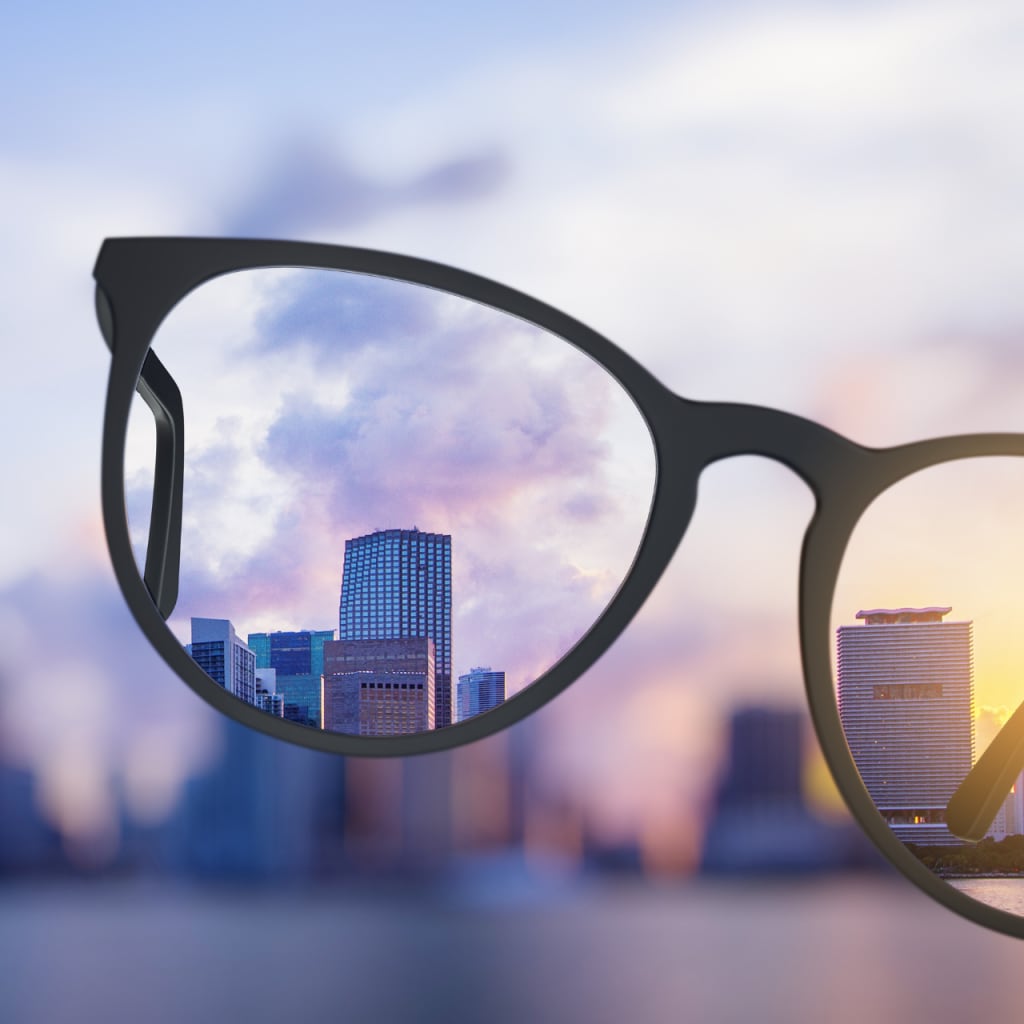
Blurry vision is one of the clearest signs that your eyes need correction, but knowing whether you are nearsighted or farsighted makes a difference in how that correction works. Both are refractive errors, meaning the eye does not focus light the way it should. They affect opposite ends of your vision and are corrected differently, whether you wear contact lenses, glasses, or both.
What Is Nearsightedness?
Nearsightedness, or myopia, means close objects are clear and distant ones are blurry. You can read a book without trouble but might struggle to see a scoreboard, read a street sign, or recognize a face across the room.
The cause is structural. Light entering the eye focuses in front of the retina instead of landing directly on it. This happens when the eyeball grows slightly too long or when the cornea curves more steeply than it should. Myopia is one of the most common vision conditions worldwide, affecting up to 50 percent of adults in some populations. It typically develops in childhood and progresses through the teenage years.
What Is Farsightedness?
Farsightedness, or hyperopia, is the opposite condition. Distance vision is usually clear, but close-up tasks like reading, writing, and screen use all cause strain, blurring, and headaches.
Light focuses behind the retina rather than directly on it. This happens when the eyeball is shorter than average or the cornea is too flat to bend light correctly. Hyperopia is usually present at birth and can be inherited. Mild farsightedness can go undetected for years because younger eyes compensate by working harder to focus. That compensation becomes more difficult with age, which is why symptoms tend to appear or worsen in adulthood.
Nearsighted vs. Farsighted Side by Side
Nearsighted (Myopia)
Farsighted (Hyperopia)
Clear Vision
Up close
At a distance
Blurry Vision
Far away
Up close
Eye Shape
Too long or cornea too curved
Too short or cornea too flat
Light Focus
In front of the retina
Behind the retina
When It Develops
Often in childhood
Often present from birth
Common Symptoms
Squinting, headaches, sitting close to screens
Eye strain, headaches, difficulty reading
Symptoms of Nearsightedness and Farsightedness
Nearsightedness and farsightedness share some symptoms but each has distinct signs worth knowing.
Myopia symptoms include blurry distance vision, squinting, sitting close to screens or the television, and headaches after driving or watching a game
Hyperopia symptoms include blurry close-up vision, eye strain during reading or screen use, headaches after close-up tasks, and holding books or phones further away to focus
Children rarely report vision problems on their own. Watch for squinting, sitting too close to screens, frequent eye rubbing, or difficulty reading at school. Early detection makes correction much simpler.
How Glasses Correct Nearsightedness and Farsightedness
Glasses work by placing a corrective lens in front of the eye to redirect light before it enters. For myopia, glasses use concave lenses that spread light slightly outward, shifting the focal point back onto the retina. For hyperopia, convex lenses bend light inward to move the focal point forward so it lands where it should.
The prescription number on your glasses tells you the strength of correction needed. A minus sign indicates myopia. A plus sign indicates hyperopia. The further the number from zero, the stronger the lens required.
Contact lenses work the same way as glasses but sit directly on the cornea. This gives them a wider field of corrected vision since the lens moves with your eye rather than staying fixed in a frame.
Contacts for myopia shift the focal point backward onto the retina. Contacts for hyperopia do the opposite, moving the focal point forward. Single-vision lenses cover the majority of prescriptions for both conditions. Daily disposables are a convenient option since each day starts with a fresh lens. Silicone hydrogel lenses allow more oxygen through to the cornea, a solid choice for people who wear contacts for long stretches of the day.
Can You Be Both Nearsighted and Farsighted?
It is possible, though uncommon. Each eye can develop independently, and in rare cases one eye is nearsighted while the other is farsighted. Astigmatism can also occur alongside either condition, requiring toric lenses or glasses with a cylindrical correction.
As people age, a condition called presbyopia develops on top of any existing refractive error. Presbyopia affects the eye’s ability to focus on close objects and is a normal part of aging, usually becoming noticeable from the mid-40s onward. Bifocal or progressive glasses and multifocal contact lenses handle both near and distance correction, removing the need to switch between pairs.
Once you have a current prescription, 1-800GetLens carries contact lenses for myopia, hyperopia, astigmatism, and presbyopia. If you are also looking for glasses, your prescription works for both.
References
American Optometric Association. Myopia. AOA.org. 2023.
American Optometric Association. Hyperopia. AOA.org. 2023.
American Academy of Ophthalmology. Farsightedness Hyperopia. AAO.org. 2023.
Holden BA, et al. Global Prevalence of Myopia and High Myopia. Ophthalmology. 2016.