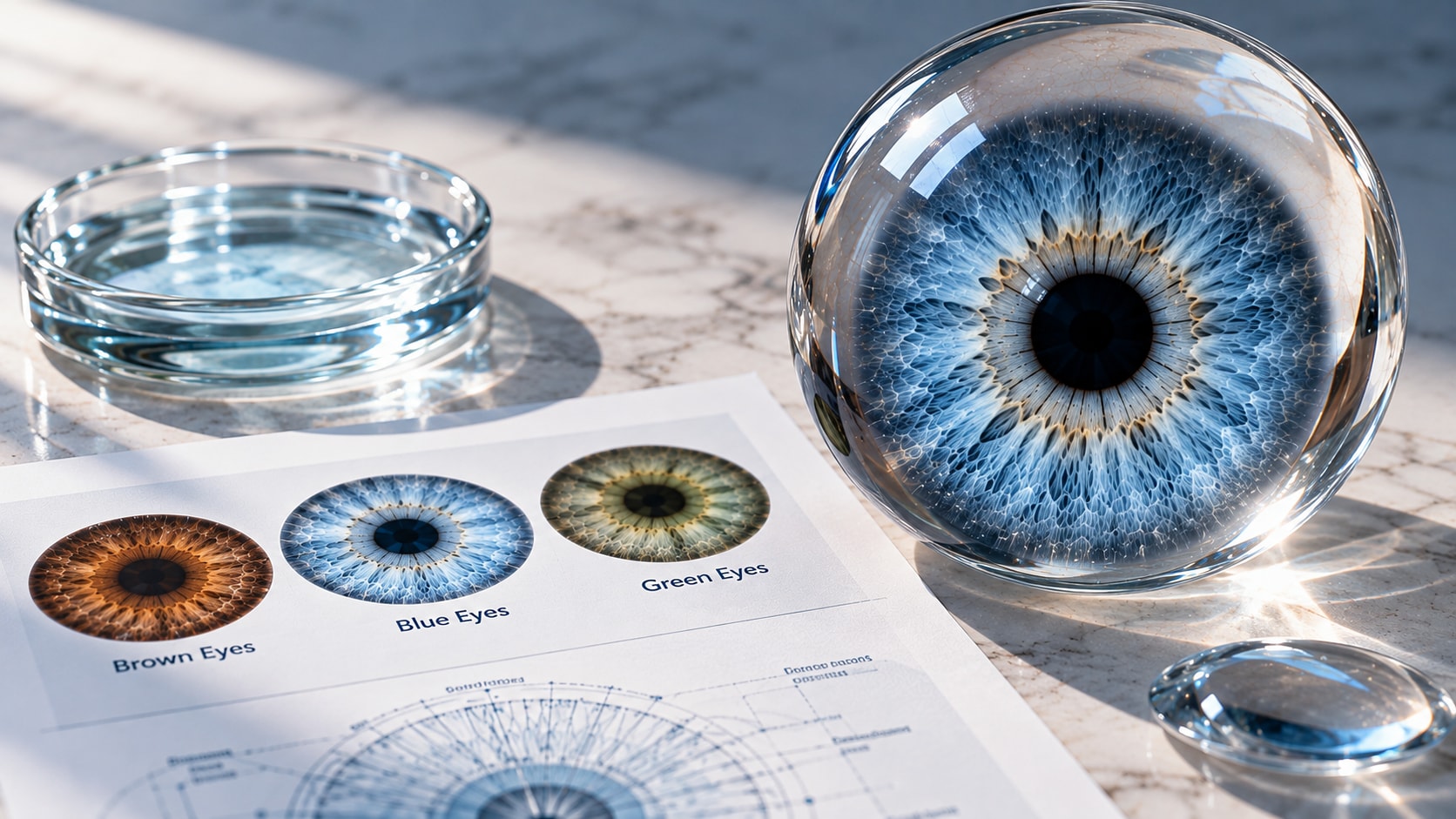
Ever noticed how some blue eyes look almost gray indoors but turn bright blue in the sunlight? Or wondered why two brown-eyed parents can have a baby with blue eyes? There’s more to this eye color than meets the eye.
Only about 8% to 10% of the world’s population has blue eyes, making them relatively rare. Beyond their distinctive color, blue eyes have an interesting history tied to genetics, ancient ancestry, and the unique way they interact with light. These factors also help explain why blue eyes can look different from person to person and even change in appearance depending on the lighting.
5 Interesting Facts About Blue Eyes
Blue eyes are a natural example of how human traits can vary across generations. Their inheritance is not always predictable, and no single gene determines a person’s exact eye color. This makes eye color a fascinating subject in the study of human genetics.
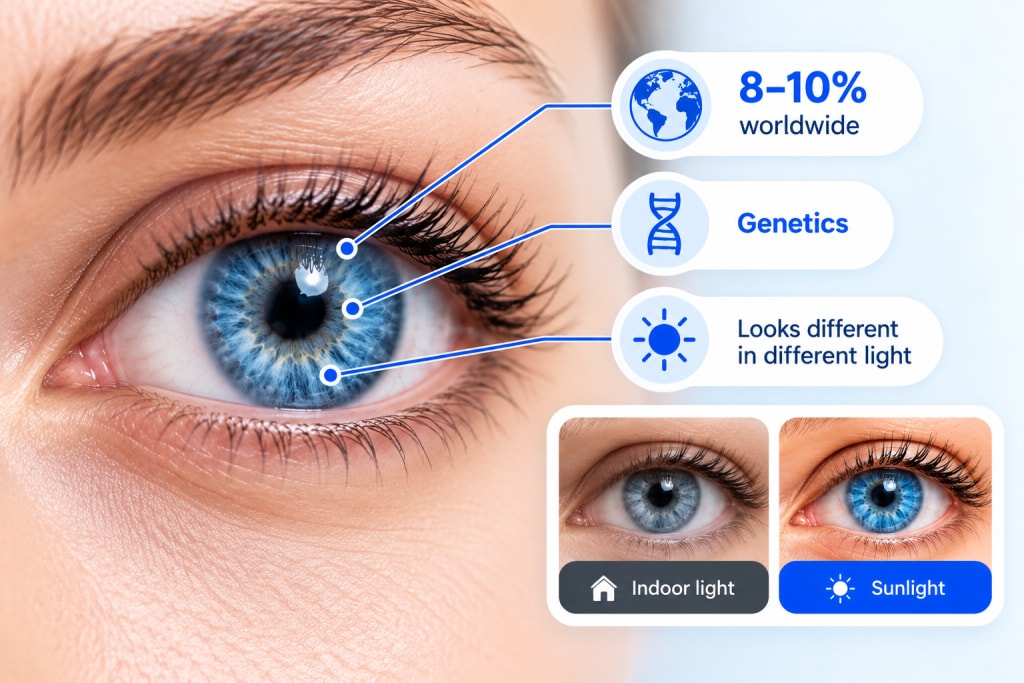
Blue eyes may also look simple at first glance, but their color has a surprisingly complicated backstory. Here are 5 facts worth knowing.
- Blue eyes don’t actually contain blue pigment.
Their color comes from how light scatters through the iris. Because blue eyes have relatively little melanin, shorter wavelengths of light scatter back, creating their blue appearance. - Only about 8% to 10% of people worldwide have blue eyes.
Brown eyes are much more common globally, while blue eyes are estimated to occur in roughly one in every 10 to 12 people. - Blue eyes are linked to an ancient genetic mutation.
A variation in a regulatory region of the HERC2 gene affects melanin production in the iris and plays a major role in determining blue or brown eye color. - Many blue-eyed people share a distant genetic ancestor.
A 2008 study found evidence that many people with blue eyes inherited the same ancient genetic variation, suggesting a shared ancestral origin. - Two brown-eyed parents can have a blue-eyed child.
Eye color is influenced by several genes, so two parents with brown eyes can sometimes have a baby with blue eyes.
How Rare Are Blue Eyes?
Blue eyes are relatively rare worldwide, although how unusual they seem depends largely on where you live. Compare that with brown eyes, which account for the majority of the world’s population, and it’s easy to see why blue is considered an uncommon eye color. For a closer comparison, check out these facts about brown eyes.
But those percentages tell only part of the story.
What Percentage of People Have Blue Eyes?
In the United States, blue eyes are considerably more common than the global average of 8% to 10%. According to a 2014 Harris Poll cited by the American Academy of Ophthalmology, approximately 27% of Americans have blue eyes, or roughly one in four people.
This higher percentage is partly linked to the country’s population demographics and European ancestry, particularly from regions where blue eyes are more prevalent. It also explains why blue eyes may seem fairly common in some American communities, even though they remain relatively rare worldwide.
Where Are Blue Eyes Most Common?
Blue eyes are especially prevalent in Northern Europe, particularly among populations in Finland, Estonia, and nearby countries. Genetic ancestry helps explain this distribution. Variations associated with blue eyes became more common in certain European populations over many generations. Still, blue eyes aren’t exclusive to Europe. They can also occur in people of Asian, Middle Eastern, African, and other ancestral backgrounds. Although less common in some populations, blue eyes are not limited to any single region or ancestry.
Are Blue Eyes the Second-Rarest Eye Color?
Not necessarily. Blue eyes are less common than brown eyes worldwide, but green eyes are generally considered rarer. Gray eyes may also be less common, depending on how eye colors are classified. The confusion comes from the fact that eye color isn’t divided into perfectly clear categories. Some people have gray-blue, blue-green, or hazel eyes that don’t fit neatly into one group. So while blue eyes are uncommon, calling them the second-rarest eye color isn’t always accurate.
What Causes Blue Eyes?
Here’s the interesting part: blue eyes aren’t blue because of a blue-colored substance inside them. Their appearance comes from a combination of low melanin concentration and the way light interacts with the iris.
Why Are Blue Eyes Blue if They Have No Blue Pigment?
Think about how the sky looks blue even though the air itself isn’t blue. A somewhat similar optical principle helps explain blue eyes. When light enters the iris, it interacts with tiny structures within the tissue. In an iris with relatively little melanin near the front, shorter wavelengths of visible light are scattered more effectively, producing the blue color we see.
That means blue eyes aren’t painted blue by pigment. Their color is largely the result of how light behaves. It’s also why blue eyes can look different depending on the lighting around them.
Do Blue Eyes Have Less Melanin Than Brown Eyes?
Yes. The amount and distribution of melanin in the iris are major factors in determining eye color. People with brown eyes have more melanin in the front layers of their irises. That pigment absorbs more incoming light, giving the eyes their brown appearance.
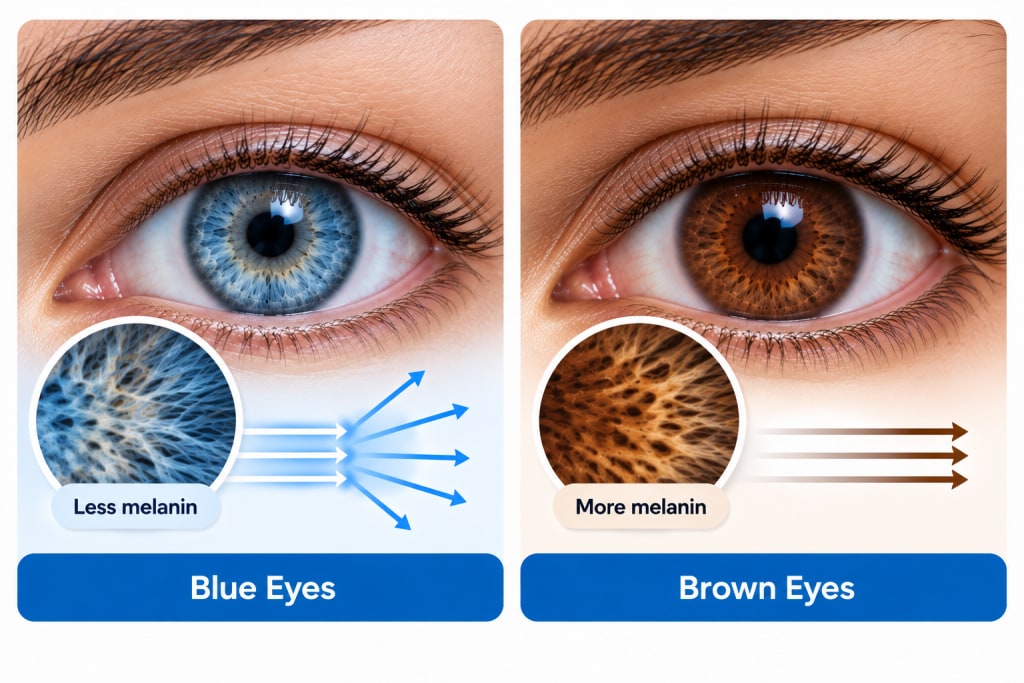
People with blue eyes have considerably less melanin in those layers. With less pigment absorbing light, the scattering effect becomes more noticeable. Both eye colors contain melanin. The difference is mainly how much is present and where it’s distributed.
Where Do Blue Eyes Come From?
Blue eyes have a long genetic history, and scientists have spent decades investigating how they developed and spread. One of the most interesting discoveries came from researchers at the University of Copenhagen, who identified a genetic variation strongly associated with blue eye color.
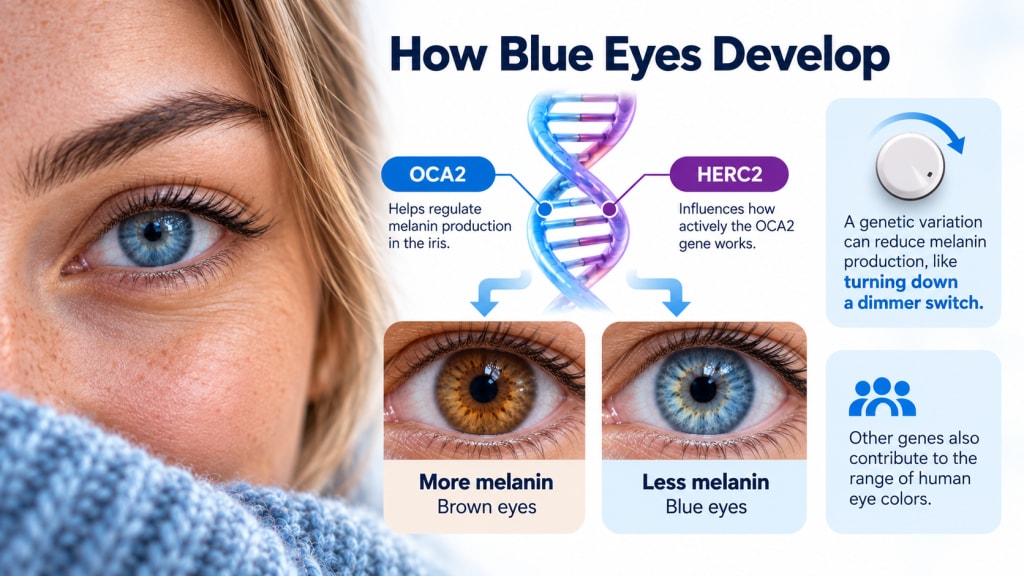
Two genes play particularly important roles in determining human eye color (OCA2 and HERC2). The OCA2 gene helps regulate the production and processing of melanin. The nearby HERC2 gene contains a regulatory region that influences how actively OCA2 works. A variation in this regulatory region can reduce melanin production in the iris, making blue eyes more likely.
You can think of it as a dimmer switch. Instead of shutting down pigment production completely, the genetic variation turns down the amount produced in certain parts of the iris. But it isn’t the only genetic factor involved. Several other genes contribute to the range of human eye colors. For a broader look at inherited eye colors, see eye color types and genetics.
What Are the Different Shades of Blue Eyes?
Blue eyes range from pale, silvery blue to deep blue with hints of green. These shades of blue eyes vary due to iris pigmentation, structure, and lighting. For those looking to change or enhance their natural eye color, cosmetic contact lenses are another option.
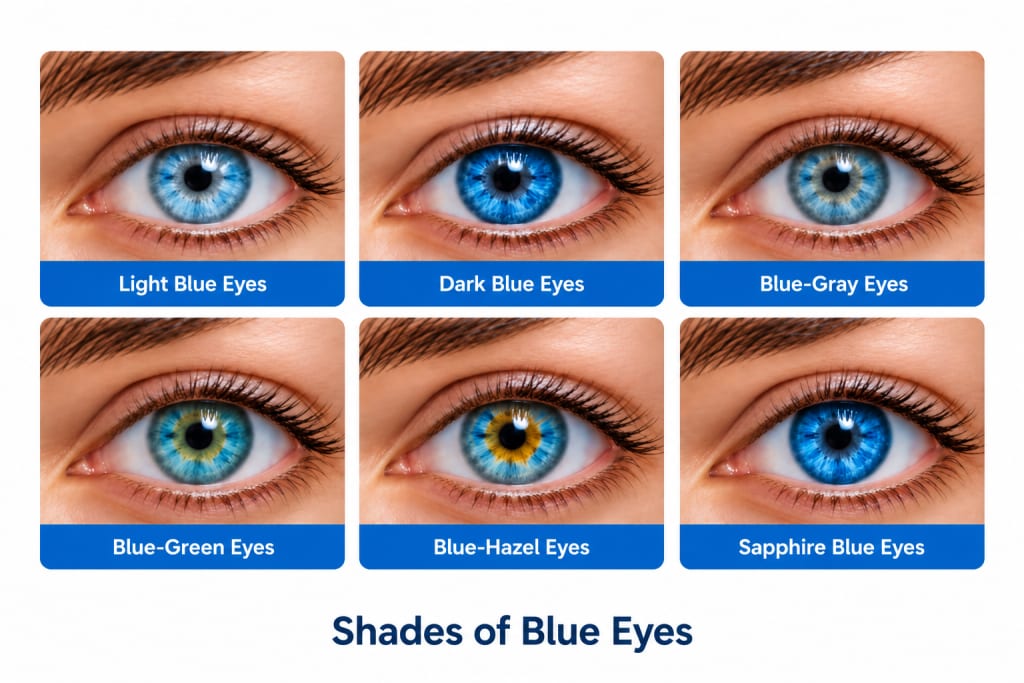
Light Blue Eyes
Light blue eyes have a pale, sometimes icy appearance. They may look especially bright outdoors or under strong natural lighting because there’s relatively little visible pigment in the front layers of the iris. Some are so pale that they appear almost silver or gray.
Dark Blue Eyes
Dark blue eyes have a deeper, richer appearance. Some look almost navy under certain lighting conditions, particularly when they have a pronounced dark outer iris border. In dim lighting, these darker tones may look noticeably less vibrant than they do in daylight.
Blue-Gray Eyes
Blue-gray eyes combine blue and gray tones. Depending on the lighting, they may appear more silver, slate, or blue. These subtle differences can make it difficult to determine whether someone’s eyes are primarily blue or gray.
Blue-Green Eyes
Blue-green eyes show a mixture of blue and greenish tones. This blue-green eye color may be influenced by differences in pigmentation and the way light scatters through the iris. Some irises look predominantly blue with green areas near the pupil, while others appear more evenly blended.
Blue-Hazel Eyes
Blue-hazel eyes is an informal description sometimes used for irises that show blue alongside green, gold, or brownish tones. Unlike uniformly blue eyes, these mixed-color appearances can contain noticeable differences in pigmentation across the iris. They’re often difficult to classify under a single eye-color label.
If you’d like to experiment with a different shade, color disposable contact lenses can temporarily change or enhance your natural eye color when prescribed and properly fitted.
Can Blue Eyes Change Color Over Time?
Yes, especially during early childhood. But there’s a difference between an eye color that genuinely changes and one that simply looks different under certain lighting.
Why Do Some Babies' Blue Eyes Change Color?
Some babies are born with blue or grayish eyes that become greener, hazel, or brown as they grow. That’s because melanin production in the iris can continue developing after birth.
As more pigment accumulates, the baby’s eye color may gradually darken. These changes are often noticeable during the first year, although some children’s eye colors continue developing beyond that. And despite the popular belief that all newborns have baby blue eyes, that’s not actually true. Many babies are born with brown eyes, and their eye color may remain brown throughout their lives.
Can Blue Eyes Change Color as You Get Older?
Blue eyes generally remain relatively stable once their color has fully developed. Gradual changes in iris appearance can sometimes occur with age. Certain medical conditions, injuries, and medications may also affect eye color. If one or both eyes suddenly change color, particularly alongside discomfort or changes in vision, it’s worth having an eye doctor check them.
Benefits or Risks to Having Blue Eyes
Does having blue eyes provide any special advantages? The answer is more complicated than you might expect. Blue eyes are a normal variation in human pigmentation. They aren’t inherently healthier or less healthy than brown eyes, although research has identified certain differences associated with lighter iris color.
| Condition or Concern | How It Relates to Blue Eyes |
|---|---|
| Light Sensitivity (Photophobia) | Lower iris pigmentation may increase glare and light sensitivity |
| Uveal Melanoma | Lighter eye colors are associated with higher melanoma risk |
| Age-Related Macular Degeneration (AMD) | Some studies suggest an association, but evidence remains mixed |
| Sunlight and Glare | Less iris pigment may contribute to greater light scattering |
People with blue eyes can protect their vision by wearing sunglasses that block 99% to 100% of UVA and UVB rays, scheduling routine eye exams, and paying attention to persistent symptoms such as eye pain, blurred vision, or unusual light sensitivity. Although blue eyes light sensitivity may be more noticeable in some people due to lower iris pigmentation, eye color alone doesn’t determine overall eye health.
Can You Wear Colored Contacts with Blue Eyes?
Yes, you can wear colored contact lenses even if you naturally have blue eyes. If you want to enhance your natural shade or try a different color, there are several options. Enhancement tints can make blue eyes appear brighter or more defined, while opaque lenses can create a noticeable change.
You can try shades like green, gray, hazel, or violet, depending on your preferred look. If you’re looking for affordable options, cheap colored contact lenses provide different shades and prescription choices. The final appearance depends on your natural eye color, lens design, and lighting. For more tips on choosing a shade and caring for your lenses, read our guide to colored contact lenses. All colored contacts, including those without vision correction, require a valid prescription and proper fitting by an eye care professional.
What Do Blue Eyes Mean?
Blue eyes have attracted attention for centuries, appearing in art, literature, folklore, and popular culture. In some traditions, they’re associated with calmness, clarity, innocence, or mystery. In others, blue eyes carry spiritual or symbolic meanings influenced by local beliefs. But those interpretations are cultural, not biological.
There’s no reliable scientific evidence that having blue eyes makes someone more trustworthy, creative, intelligent, or emotionally sensitive. Your eye color can tell researchers something about pigmentation and genetics, but it doesn’t define your personality.
Learn More About Blue Eyes
Get clear answers to common questions about blue eyes, including their unique appearance, genetics, night vision, natural color changes, and sensitivity to light.
What Is Special About Blue Eyes?
Blue eyes are special because of their relative rarity, their genetic history, and the way they get their color. Unlike brown eyes, blue eyes don't rely on blue pigment. Their appearance comes largely from light scattering within an iris that contains relatively little melanin.
Do People with Blue Eyes Have Better Night Vision?
Not necessarily. A small study has suggested a possible advantage under particular low-light conditions, but the findings aren't enough to conclude that blue-eyed people generally have better night vision. Eye health and other visual factors matter much more than iris color alone.
Can Blue Eyes Skip a Generation?
Yes. Eye color inheritance involves multiple genes, so genetic variants associated with blue eyes can pass through generations without producing blue eyes in every family member. That's one reason a child may have blue eyes even when both parents have brown eyes.
Can Blue Eyes Turn Green Naturally?
Blue eyes can appear greenish under certain lighting conditions, especially when the iris contains mixed blue and green tones. But a permanent change from blue to green is uncommon after childhood. If your eye color suddenly changes, it's best to have an eye doctor check for an underlying cause.
Are Blue Eyes More Common in Men or Women?
Blue eyes occur in both men and women. Some population studies have found differences in eye-color distribution between sexes, but the findings aren't consistent enough to conclude that blue eyes are universally more common in either group. Genetics and ancestry play much larger roles in determining eye color.
Are Blue Eyes Sensitive to Light?
Blue eyes contain less melanin than darker eyes, which may make them more sensitive to bright light and glare. Melanin helps absorb stray light inside the eye, so people with blue eyes may experience more discomfort in sunlight or brightly lit environments. A light sensitivity varies from person to person, and not everyone with blue eyes experiences it.
Disclaimer: The information provided is intended for educational purposes only and should not replace professional medical guidance, diagnosis, or treatment.
References
Your Blue Eyes Aren’t Really Blue. American Academy of Ophthalmology. URL: https://www.aao.org/eye-health/tips-prevention/your-blue-eyes-arent-really-blue Date Accessed: October 22, 2026.
Is Eye Color Determined by Genetics? MedlinePlus Genetics, National Library of Medicine, National Institutes of Health. URL: https://medlineplus.gov/genetics/understanding/traits/eyecolor/ Date Accessed: October 22, 2026.
Blue Eye Color in Humans May Be Caused by a Perfectly Associated Founder Mutation in a Regulatory Element Located Within the HERC2 Gene Inhibiting OCA2 Expression. Hans Eiberg et al., Human Genetics. URL: https://pubmed.ncbi.nlm.nih.gov/18172690/ Date Accessed: October 22, 2026.
When Do Babies’ Eyes Change Color? Cleveland Clinic. URL: https://health.clevelandclinic.org/when-do-babies-eyes-change-color Date Accessed: October 22, 2026.
Intraocular (Uveal) Melanoma Treatment (PDQ®)–Patient Version. National Cancer Institute, National Institutes of Health. URL: https://www.cancer.gov/types/eye/patient/intraocular-melanoma-treatment-pdq Date Accessed: October 22, 2026.
Yes, Your Eyes Can Change Colors — and Here’s Why. Cleveland Clinic. URL: https://health.clevelandclinic.org/can-eye-color-change Date Accessed: October 22, 2026.
Iris Color and Visual Functions. Peer-reviewed research indexed in PubMed, National Library of Medicine. URL: https://pubmed.ncbi.nlm.nih.gov/22527312/ Date Accessed: October 22, 2026.
Iris Color, Skin Sun Sensitivity, and Age-Related Maculopathy: The Blue Mountains Eye Study. Paul Mitchell et al., Ophthalmology. URL: https://pubmed.ncbi.nlm.nih.gov/9709743/ Date Accessed: October 22, 2026.