Not really. Green eyes don’t fit neatly into a dominant or recessive box. The old textbook version ranks green above blue but below brown, but research has shown that eye color is a lot messier than that. Several genes work together to set the pigment in your iris.
Genes such as OCA2 and HERC2 play a part, which is why kids don’t always end up with the same eye color as their parents. Those same gene combinations also go a long way toward explaining why green eyes are so rare worldwide.
Are Green Eyes a Dominant or Recessive Trait?
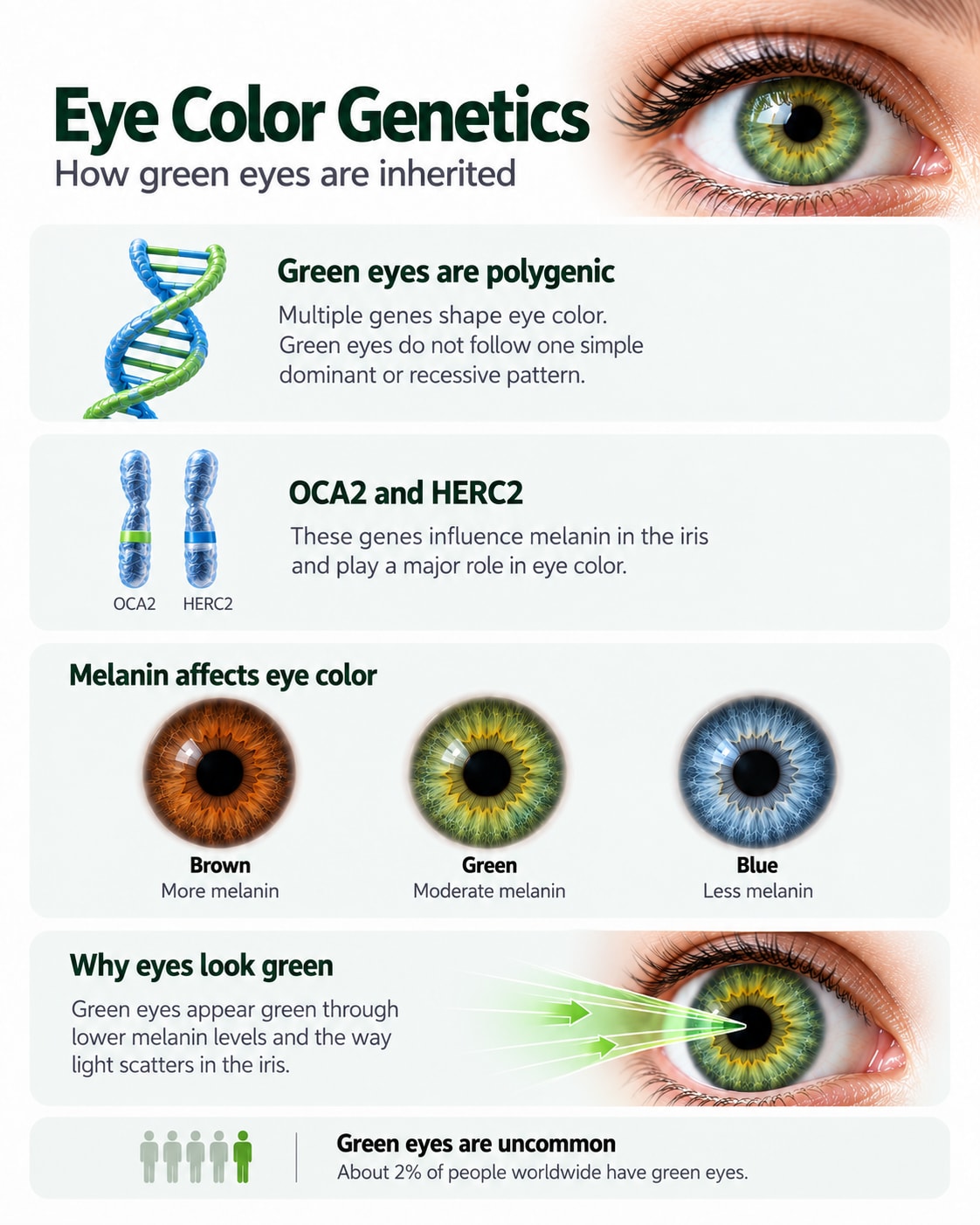
Green eyes don’t follow a simple dominant or recessive pattern. In the traditional model, brown sits on top, green comes next, and blue lands at the bottom.
However, that model leaves out the many genes behindeye color types and genetics. Green eyes come from inherited variations that affect how much melanin the iris makes, so you can’t reliably guess a child’s eye color just by looking at the parents.
What Genes Determine Green Eye Color?
Green eye genetics involves several genes that influence melanin levels in the iris. Two of the most extensively studied are OCA2 and HERC2, located on chromosome 15.
How OCA2 and HERC2 Influence Eye Color
OCA2 helps control how much melanin the iris produces, and a regulatory region inside HERC2 influences how active OCA2 is. Small variations in either gene can shift iris pigmentation, which helps account for the difference between brown, blue, and green eyes.
Why Green Eyes Follow Polygenic Inheritance
Polygenic inheritance means multiple genes contribute to one characteristic. Besides OCA2 and HERC2, genes like TYR and SLC24A4 also affect pigmentation. They all work together, which is why eye color doesn’t follow tidy dominant and recessive rules.
How Are Green Eyes Inherited From Parents?
Green eye inheritance depends on genetic variants passed down from both parents. A parent’s visible eye color doesn’t reveal every pigmentation-related variant they carry.
Two brown-eyed parents can have a green-eyed child if the variants the child inherits lead to lighter iris pigmentation.
Two blue-eyed parents can also have a green-eyed child, thanks to gene combinations that affect melanin production.
Two green-eyed parents can have a brown-eyed child, though that’s less common.
Can Two Brown-Eyed Parents Have a Green-Eyed Child?
Yes. Brown-eyed parents can carry variants linked to lighter pigmentation without showing them. A child can inherit the right mix and end up with green eyes, even though both parents have brown.
Can Two Blue-Eyed Parents Have a Green-Eyed Child?
Yes, but it’s uncommon. Since more than one gene affects eye color, two blue-eyed parents can still have a green-eyed child if the variants they pass down create a different pigmentation pattern.
What Causes Green Eyes?
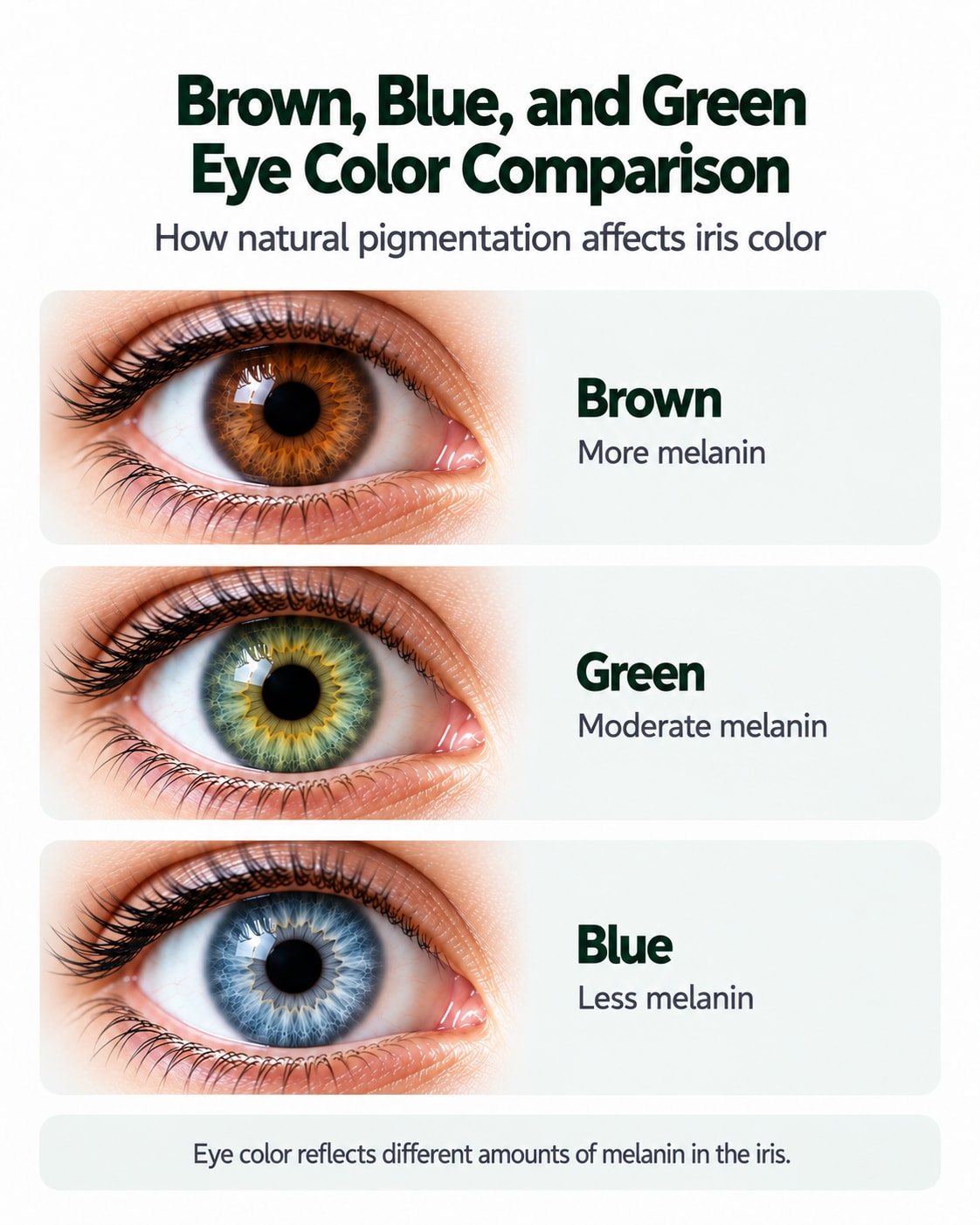
Green eyes develop through relatively low to moderate melanin levels and the interaction of light with the iris. Unlike brown eyes, which contain more melanin, green eyes have less pigment in their front layers.
How Melanin and Light Scattering Create Green Eye Color
There’s no actual green pigment in natural green eyes. The color comes from light scattering inside the iris, mixed with yellowish or brownish pigment. Depending on how much melanin is there, the shade can land anywhere from gray-green to golden-green.
How Rare Are Green Eyes Worldwide?
Only about 2% of people worldwide have green eyes, which makes them one of the rarest natural eye colors that people commonly recognize.
Green eyes show up more often in people with northern and central European ancestry, but anyone can inherit them. Their rarity comes down to how the variants tied to lighter iris pigmentation are spread across populations.
Green Eyes vs. Hazel Eyes
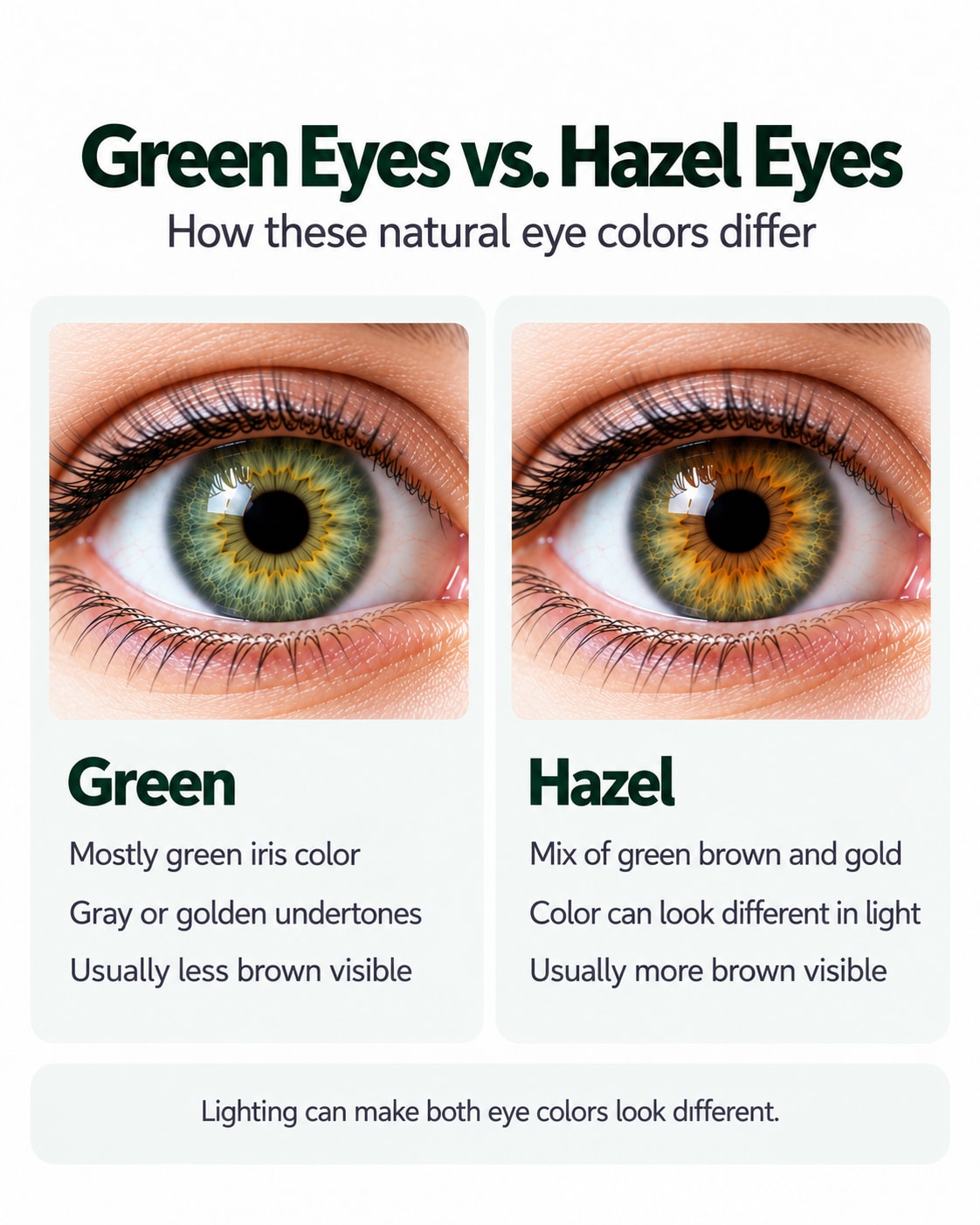
Green and hazel eyes share similar pigmentation characteristics, but their visible colors differ in several ways.
Green eyes usually look mostly green, sometimes with gray or golden undertones.
Hazel eyes tend to show a mix of brown, green, and gold, often with a darker ring around the pupil.
Lighting can change how both colors look, because of light scattering and pigmentation.
The differences become more apparent when comparinghazel vs. green eyes under consistent lighting. For a temporary change,hazel contact lenses can create a similar blend of green, brown, and golden tones.
Can Green Eyes Change Color Over Time?
Green eyes can look different without undergoing permanent pigmentation changes. Several factors influence their appearance.
Lighting can make them look lighter, darker, or more golden.
Clothing and makeup change the colors around the iris, which changes how it stands out.
In childhood, eye color can shift gradually as melanin builds up.
Significant eye color changes during adulthood, particularly in one eye, warrant an eye examination. For a temporary look,color contact lenses online come in shades that can make brown eyes appear green. Opaque designs cover darker irises better, while translucent ones give a more subtle change. Even decorativecontact lenses without prescription power require a valid prescription and professional fitting.
Are Green Eyes More Sensitive to Light?
People with green eyes can be more sensitive to bright sunlight due to lower melanin levels in the iris. Melanin absorbs light, so lighter pigmentation can contribute to greater visual discomfort.
Still, eye color alone doesn’t decide how light-sensitive you are. Everyone, whatever their eye color, should wear sunglasses that block 99% to 100% of UVA and UVB rays.
More Information About Green Eyes
Are green eyes recessive to brown eyes?
Old studies say green is recessive to brown, but newer research shows that several genes affect both colors.
Are green eyes dominant over blue eyes?
Old studies classify green as dominant over blue, although actual eye color inheritance involves multiple genes.
Can green eyes skip a generation?
Yes. The variants linked to green eyes can be passed down through a family without showing up as green eyes in every generation.
Can two green-eyed parents have a brown-eyed child?
Yes, but it’s uncommon. Certain gene combinations can produce brown eyes even when both parents have green eyes.
Can you predict a baby's eye color from their parents?
Parental eye colors can suggest possible outcomes, but multiple genes influence a child’s final eye color.
Disclaimer: This article is for informational purposes only and should not be used in place of advice, diagnosis, or treatment from a qualified medical professional.
References
Colored and Decorative Contact Lenses A Prescription Is a Must. https://www.fda.gov/consumers/consumer-updates/colored-and-decorative-contact-lenses-prescription-must. Accessed October 13, 2026.
Eye Color Unique as a Fingerprint. https://www.aao.org/eye-health/tips-prevention/eye-color-unique-as-fingerprint. Accessed October 13, 2026.
Eye Colors. https://my.clevelandclinic.org/health/articles/21576-eye-colors. Accessed October 13, 2026.
Green Eyes The Rarest Eye Color. https://www.allaboutvision.com/eye-care/eye-anatomy/eye-color/green/. Accessed October 13, 2026.
Is Eye Color Determined by Genetics? https://medlineplus.gov/genetics/understanding/traits/eyecolor/. Accessed October 13, 2026.
What Is the Rarest Eye Color? https://www.allaboutvision.com/eye-care/eye-anatomy/eye-color/rarest/. Accessed October 13, 2026.