Table of Contents
Hazel eyes can be surprisingly hard to describe with a single color. Look closely, and you may see green around one part of the iris, brown near the pupil, or flashes of gold and amber that become more noticeable under certain lighting. A hazel eye color usually contains a blend of these shades rather than one uniform tone.
That mix is part of what makes hazel eyes distinctive. Their appearance comes from the amount and distribution of melanin in the iris, along with the way light interacts with its structure. Genetics also plays a role, creating combinations that can make one person’s hazel eyes look quite different from another’s.
What Color Are Hazel Eyes?
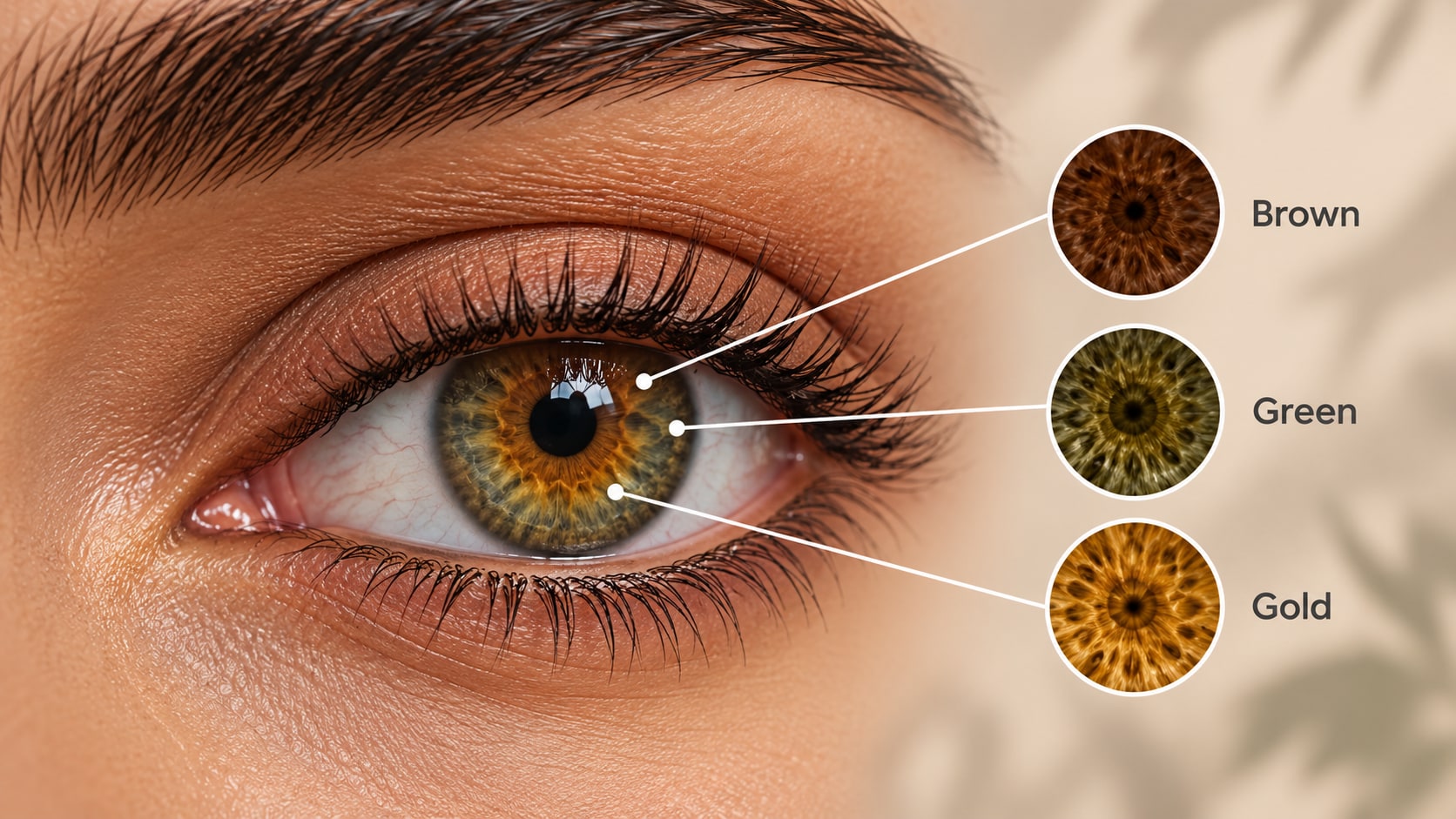
Hazel eyes are generally a combination of brown, green, and gold. The colors don’t have to appear in equal amounts. One person may have an iris that looks mostly green with a brown center, while another may have predominantly brown eyes with golden or green areas around the edges.
This variation also means hazel isn’t one fixed shade. Cleveland Clinic describes hazel as a combination of brown, gold, or green, with the balance varying from person to person. Hazel eyes also tend to contain less melanin in the front layer of the iris than brown eyes, but more than blue or green eyes.
Color transitions can be gradual, speckled, ring-shaped, or uneven across the iris. That variability is one reason two people who both describe their eyes as hazel may have noticeably different eye colors.
Common Hazel Eye Color Patterns
There isn’t a formal medical list of hazel “types.” Eye color falls along a continuum, and even researchers use different classification systems. Still, several descriptive patterns are commonly seen in eyes identified as hazel.
| Hazel Eye Pattern | What It May Look Like |
|---|---|
| Green-Dominant Hazel | Mostly green with noticeable brown, gold, or amber areas |
| Brown-Dominant Hazel | Mostly light brown with visible green or golden tones |
| Golden Hazel | Warm honey or gold shades mixed with brown and green |
| Brown-Centered Hazel | Brown is strongest near the pupil while the outer iris appears greener or lighter |
| Multi-Toned Hazel | Brown, green, gold, and amber appear as flecks, patches, or blended areas throughout the iris |
A very distinct ring of one color surrounding the pupil can sometimes resemble central heterochromia. Hazel coloring and central heterochromia aren’t necessarily the same thing, though, so visual appearance alone doesn’t always place an eye neatly into one category.
Why Do Hazel Eyes Vary in Color?
Eye color isn’t produced by a single pigment that works like paint. The appearance of the iris comes from pigmentation, iris structure, genetics, and the way incoming light interacts with the eye.
Melanin in the Iris
Melanin is the main pigment involved in human eye color. Greater amounts of melanin generally produce darker eyes, while smaller amounts are associated with lighter eye colors.
Hazel eyes fall somewhere between darker brown eyes and lighter green or blue eyes in terms of pigmentation. The amount of melanin isn’t the only factor, though. Where that pigment appears within the iris also contributes to the final color you see.
Light Scattering
Light also influences how an iris appears. When light enters the eye, it interacts with pigment and the microscopic structure of the iris. Differences in that interaction contribute to the lighter green, gold, or grayish tones that can appear alongside brown pigmentation.
The effect is similar to why lighter eyes don’t need blue or green pigment to look blue or green. Their visible color results partly from how light is absorbed and scattered rather than from a corresponding blue or green pigment.
Pigment Distribution
Melanin isn’t always distributed uniformly across the visible iris. Some hazel eyes have more brown near the pupil and lighter green toward the outside. Others show gold flecks, irregular patches, or blended areas throughout the iris.
These patterns create the layered appearance associated with hazel eyes. Iris structure can also create subtle areas of darker or lighter color, adding even more variation between individuals.
Hazel Eyes vs Other Eye Colors
Eye colors exist along a spectrum rather than fitting perfectly into a handful of categories. Researchers don’t even use one universally accepted classification system for iris color, which helps explain why hazel can sometimes be mistaken for green, amber, or light brown.
One of the trickier comparisons is hazel vs green eyes since both may show noticeable green tones.
Hazel can sit visually between several of these categories, especially when one shade dominates more than the others.
| Eye Color | Typical Appearance | How It Differs From Hazel |
|---|---|---|
| Hazel | Mixture of brown, green, gold, or amber tones | Multiple colors are commonly visible within the same iris |
| Brown | Light to very dark brown | Usually has more melanin and a more consistently brown appearance |
| Green | Green, gray-green, or yellow-green | Typically has less brown pigmentation than hazel |
| Blue | Blue to blue-gray | Has very little melanin in the front layer of the iris |
| Amber | Gold, copper, or yellow-brown | Usually appears more uniformly golden or copper rather than mixed with green |
How Rare Are Hazel Eyes?
Hazel eyes are much less common worldwide than brown eyes. A 2020 scientific review estimated that about 5% of the global population has hazel eyes. The same review estimated brown eyes at roughly 79%, blue at 8% to 10%, and green at about 2%.
That percentage should be treated as an estimate rather than an exact global count. Eye-color categories vary between studies, and the line separating hazel from green, amber, or light brown isn’t always defined the same way.
Where you live can also affect how unusual hazel eyes appear. Eye-color frequencies differ among populations due to ancestry and the genetic variants present within those populations.
Why Do Hazel Eyes Look Different?
Hazel eyes have a reputation for “changing color,” but the pigment in an adult iris doesn’t normally shift from brown to green and back again over the course of a day. What usually changes is how the existing colors are perceived.
- Bright sunlight can make gold and green portions of the iris appear more noticeable than they do under dim indoor lighting.
- Warm or cool artificial lighting can emphasize different tones within the eye, making the same iris look browner, greener, or more golden.
- Changes in pupil size alter how much of the iris is visible and can slightly change the balance of colors you notice.
- Clothing and makeup can create contrast around the eyes. Purple, plum, bronze, copper, and certain greens may draw attention to different tones already present in hazel eyes.
- Hair color, skin tone, and nearby colors can also influence how the eye color is perceived.
These changes affect appearance, not the underlying amount of pigment in the iris.
Best Contact Colors for Hazel Eyes
A genuine change in iris color is different from the everyday shifts in appearance described above. Changes in pigmentation can sometimes occur with aging, certain medications, eye injuries, or conditions affecting the iris.
Consider scheduling an eye exam if you notice:
- A sudden color change in one eye
- New or expanding areas of pigmentation
- An eye color change following an injury
- Redness, pain, or light sensitivity along with a color change
- Changes in vision at the same time
An eye care professional can examine the iris and determine whether the color change needs further evaluation.
Contact Lens Colors for Hazel Eyes
Colored contacts can either emphasize the tones already present in hazel eyes or create a more noticeable change. Your natural iris color, the opacity of the lens, and the design of its color pattern will affect the final appearance.
If you’re considering hazel eye contacts or another colored lens, different shades can create different effects.
- Green lenses can bring the greener side of hazel eyes forward and may create a brighter overall appearance.
- Honey or amber lenses can emphasize warm gold and brown tones.
- Brown lenses can create a deeper, more uniform eye color while staying close to the natural shades already present.
- Gray lenses can cool down the warmth of hazel eyes and create stronger contrast.
- Blue lenses can produce a more noticeable transformation, particularly when the lens has enough opacity to cover darker portions of the iris.
Colored contact lenses aren’t cosmetic products that you can safely treat as one-size-fits-all accessories. In the United States, all contact lenses, including decorative lenses that don’t correct vision, require a prescription and proper fitting.
How to Make Hazel Eyes Stand Out
You don’t have to change your eye color to draw more attention to it. Small choices around the eyes can emphasize different shades already present in the iris.
- Purple and plum makeup can contrast with green tones and make them appear more noticeable.
- Bronze, copper, and gold can complement warmer brown and golden areas.
- Green clothing can draw attention to green within the iris, while warmer neutrals may emphasize brown and amber tones.
- Colored contact lenses can temporarily deepen or shift the apparent color when prescribed and fitted properly.
- Sunglasses outdoors protect your eyes from ultraviolet exposure while also reducing squinting in bright conditions.
The effect will vary from person to person since hazel eyes don’t all contain the same balance of colors.
Learn More About Hazel Eyes
Are hazel eyes green or brown?
Hazel eyes can contain both green and brown, along with gold or amber tones. One color may dominate, but the mixed appearance is what typically separates hazel from more uniformly green or brown eyes.
Are hazel eyes the same as amber eyes?
Not usually. Amber eyes tend to have a more uniform gold, copper, or yellow-brown appearance, while hazel eyes typically contain a mixture of brown, green, and gold tones. Eye-color categories can overlap visually, so some eyes may be classified differently depending on the system being used.
Are hazel eyes the same as central heterochromia?
No. Central heterochromia refers to a distinct color difference around the pupil compared with the outer portion of the iris. Hazel eyes can also show multiple colors or a darker center, but mixed hazel coloring doesn’t automatically mean someone has heterochromia.
Are hazel eyes dominant or recessive?
Eye color can’t be accurately described using a single dominant-versus-recessive rule. Researchers have identified numerous genes and genetic variants that contribute to iris pigmentation, so hazel eyes result from a more complex combination of inherited traits.
Can two brown-eyed parents have a child with hazel eyes?
Yes, it’s possible. A child’s eye color depends on several inherited genetic variants, not simply whether each parent has brown, blue, green, or hazel eyes. This is why children can have an eye color that doesn’t closely match either parent’s visible eye color.
Disclaimer: The content on this page is for informational purposes only and should not take the place of professional medical advice, diagnosis, or treatment.
References
Cleveland Clinic. Eye Colors. https://my.clevelandclinic.org/health/articles/21576-eye-colors. Updated March 11, 2024.
Cleveland Clinic. Heterochromia. https://my.clevelandclinic.org/health/symptoms/25112-heterochromia. Updated June 28, 2023.
Dorgaleleh, S., Naghipoor, K., Barahouie, A., Dastaviz, F., & Oladnabi, M. Molecular and Biochemical Mechanisms of Human Iris Color: A Comprehensive Review. Journal of Cellular Physiology. https://pubmed.ncbi.nlm.nih.gov/32488945/. Published 2020.
Imesch, P. D., Wallow, I. H., & Albert, D. M. The Color of the Human Eye: A Review of Morphologic Correlates and of Some Conditions That Affect Iridial Pigmentation. Survey of Ophthalmology. https://pubmed.ncbi.nlm.nih.gov/9154287/. Published February 1997.
Mackey, D. A., Wilkinson, C. H., Kearns, L. S., & Hewitt, A. W. Classification of Iris Colour: Review and Refinement of a Classification Schema. Clinical & Experimental Ophthalmology. https://pubmed.ncbi.nlm.nih.gov/21176045/. Published 2011.
U.S. Food and Drug Administration. Colored and Decorative Contact Lenses: A Prescription Is A Must. https://www.fda.gov/consumers/consumer-updates/colored-and-decorative-contact-lenses-prescription-must.