You’ve probably heard someone say they have 20/20 vision, or maybe your eye doctor even told you the same thing. Then, not long after, you find yourself holding your phone farther away just to read a text message or reaching for a pair of reading glasses at a restaurant. It feels confusing. How can your vision be “perfect” if close-up words suddenly look blurry?
Having 20/20 vision simply means you can see clearly at a distance. It doesn’t measure how well your eyes focus on nearby objects, which is why millions of adults eventually need help with close-up vision as they get older. Reading glasses are the most familiar solution, but contact lens wearers have options too. So, why does near vision change even when your distance vision remains clear?
What 20/20 Vision Tells You
The 20/20 result comes from the familiar eye-chart test. The first number represents the distance you’re standing from the chart, while the second describes the distance at which someone with standard visual acuity can read the same line. In other words, 20/20 vision means you can see at 20 feet what a person with typical eyesight can also see at 20 feet.
That number tells your eye doctor how clearly you can make out details at a distance, but it doesn’t give a complete picture of how your eyes work. It doesn’t explain how well your eyes focus up close, adjust between different distances, work together, perceive depth, or see to the sides.
That’s why someone can have 20/20 distance vision their entire life and still begin holding reading material farther away. Presbyopia isn’t a sign that your previously clear vision has suddenly failed. It affects the eye’s ability to adjust its focus for close work, which is separate from the distance clarity measured on an eye chart. Since this change happens naturally with age, even people who have never needed vision correction before can eventually need help seeing up close.
Why Close-Up Vision Changes With Age
Seeing clearly across the room doesn’t mean your eyes can focus just as easily on something held in your hands. To view a nearby object, the natural lens inside each eye changes shape so it can focus the image properly. When you’re younger, that lens is flexible enough to make the adjustment quickly as you look from a distant sign to your phone, a book, or a restaurant menu.
Over time, the natural lens becomes harder and less flexible. It can no longer change shape as easily, making nearby words and objects look blurry even though your distance vision remains clear. This age-related change is called presbyopia, and it commonly becomes noticeable sometime after age 40.
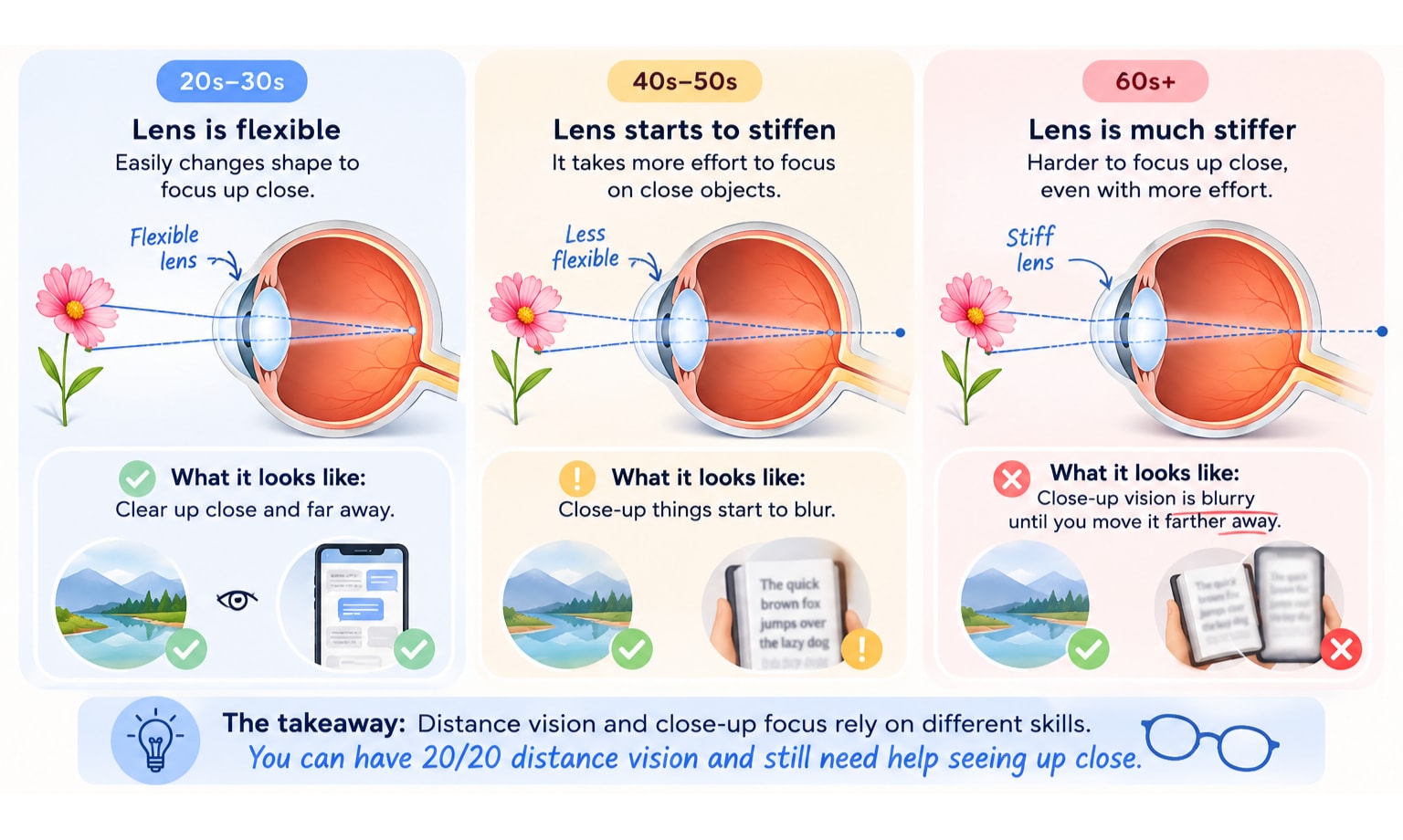
That’s why someone can have 20/20 distance vision their entire life and still begin holding reading material farther away. Presbyopia isn’t a sign that your previously clear vision has suddenly failed. It affects the eye’s ability to adjust its focus for close work, which is separate from the distance clarity measured on an eye chart. Since this change happens naturally with age, even people who have never needed vision correction before can eventually need help seeing up close.
The Most Familiar Solution Is Reading Glasses
Reading glasses are often the first solution people try. Nonprescription readers are easy to find and can work well for simple near tasks, such as reading a menu, checking a text message, or looking at a price tag. They come in different strengths, but both lenses usually have the same power, which might not suit someone whose eyes need different amounts of correction.
Prescription reading glasses are customized using the measurements from an eye exam. They can account for differences between the eyes, astigmatism, and other vision needs that drugstore readers can’t correct. Some people keep a pair nearby for close work, while others prefer glasses that can stay on throughout the day.
Then there are bifocals and progressive lenses that combine distance and near correction in one pair. Bifocals separate the two prescriptions into distinct sections, while progressives provide a gradual change between distance, intermediate, and close-up vision without a visible dividing line. These options are familiar and effective, but they aren’t the only ways to manage presbyopia.
Reading Glasses Aren't the Only Option
People who would rather not reach for reading glasses throughout the day can ask their eye doctor about multifocal contact lenses.
These lenses contain more than one prescription power, allowing the eyes to see across near, intermediate, and far distances. Instead of looking through a specific part of a lens as you would with bifocal glasses, your visual system learns to choose the clearest information for whatever you’re viewing.
Multifocal contacts can be especially convenient for people who already wear contact lenses for distance vision. Rather than switching between contacts and readers, they may be able to use one pair of lenses for checking a phone, working at a computer, driving, and handling other everyday tasks. The experience isn’t always identical to the crisp vision of single-vision correction, however, and it can take time for the eyes and brain to adjust.
Another approach is called monovision. With this setup, one contact lens is usually prescribed for distance vision and the other for near vision. The brain learns to rely more heavily on whichever eye provides the clearer image for the task at hand. Monovision works well for some people, but others notice reduced depth perception or don’t feel comfortable with the difference between their eyes.
Before you start choosing the lens you prefer, make sure you visit your eye doctor to assess your prescription, eye health, daily activities, and visual priorities. If you have the option, try out some trial lenses to find out which approach feels most natural to you.
Quick Comparison For You
Find the vision correction option that fits your lifestyle.
| Option | How It Works | Advantages | Things to Consider |
|---|---|---|---|
| 1Reading Glasses | Add focusing power for close-up tasks and are removed when they’re no longer needed. | Simple, widely available, and easy to use. | You need to keep them nearby and put them on whenever you read. |
| 2Bifocals | Divide the lens into separate distance and near-vision sections. | Provide distance and reading correction in one pair. | The visible line and sudden shift between powers can take some adjustment. |
| 3Progressive Glasses | Gradually change in power from distance to intermediate and near vision. | Cover several viewing distances without a visible dividing line. | Wearers need to look through the correct part of the lens for each task. |
| 4Multifocal Contacts | Use multiple prescription powers within each lens to support near, intermediate, and distance vision. | Can reduce the need to carry readers and work well for active routines. | Vision may take time to adapt, and the fitting may require some trial and adjustment. |
| 5Monovision Contacts | Usually correct one eye for distance and the other for near vision. | Provide a relatively simple contact lens approach to presbyopia. | Some people notice reduced depth perception or can’t comfortably adapt to the difference between their eyes. |
Reading Glasses
- How It Works
- Add focusing power for close-up tasks and are removed when they’re no longer needed.
- Advantages
- Simple, widely available, and easy to use.
- Things to Consider
- You need to keep them nearby and put them on whenever you read.
Bifocals
- How It Works
- Divide the lens into separate distance and near-vision sections.
- Advantages
- Provide distance and reading correction in one pair.
- Things to Consider
- The visible line and sudden shift between powers can take some adjustment.
Progressive Glasses
- How It Works
- Gradually change in power from distance to intermediate and near vision.
- Advantages
- Cover several viewing distances without a visible dividing line.
- Things to Consider
- Wearers need to look through the correct part of the lens for each task.
Multifocal Contacts
- How It Works
- Use multiple prescription powers within each lens to support near, intermediate, and distance vision.
- Advantages
- Can reduce the need to carry readers and work well for active routines.
- Things to Consider
- Vision may take time to adapt, and the fitting may require some trial and adjustment.
Monovision Contacts
- How It Works
- Usually correct one eye for distance and the other for near vision.
- Advantages
- Provide a relatively simple contact lens approach to presbyopia.
- Things to Consider
- Some people notice reduced depth perception or can’t comfortably adapt to the difference between their eyes.
Why Some People Prefer Contacts Over Readers
Reading glasses remain a simple and effective solution for presbyopia, but they’re not always the most convenient choice for every lifestyle. People who already wear contact lenses often prefer to continue wearing them rather than switching back and forth between contacts and readers throughout the day.
In a study of successful presbyopic contact lens wearers, 61% said convenience was the main reason they continued wearing contact lenses, while about half reported they no longer needed additional reading glasses for their everyday activities. That doesn’t mean contact lenses are the right answer for everyone, but it does show why many people choose them as an alternative when they’re a good candidate.
Of course, convenience should not be the only factor you consider. Multifocal and monovision contact lenses require a professional fitting, and your eyes and brain may need time to adjust before they feel completely natural.
Which Options Sound Most Like You?
Reading Glasses
Perfect for occasional reading, checking your phone, or looking at restaurant menus.
Biofinity Multifocal
Designed to help with near, intermediate, and distance vision in a single pair of contact lenses.
Monovision
Often fitted using lenses like ACUVUE OASYS® or Biofinity®, with one eye corrected for distance and the other for near vision.
Find the Right Correction for Your Eyes
Having 20/20 vision and needing help reading aren’t contradictory. They simply describe two different parts of how your eyes work. Once you understand that difference, choosing the right support for near vision becomes much less confusing.
The best option will depend on your prescription, eye health, comfort, daily routine, and how often you switch between near and far tasks. An eye doctor can help you compare reading glasses, monovision, and multifocal contacts to find what feels most natural for you. When contact lenses are the right fit, 1800GetLens makes it easier to find the lenses you need and keep your vision routine on track.
References
- What Does 20/20 Vision Mean? American Academy of Ophthalmology. https://www.aao.org/eye-health/tips-prevention/what-does-20-20-vision-mean Updated February 25, 2025. Accessed August 6, 2026.
- Visual Acuity. American Optometric Association. https://www.aoa.org/healthy-eyes/vision-and-vision-correction/visual-acuity Accessed August 6, 2026.
- Presbyopia. National Eye Institute. https://www.nei.nih.gov/eye-health-information/eye-conditions-and-diseases/presbyopia Updated July 25, 2019. Accessed August 6, 2026.
- Types of Refractive Errors. National Eye Institute. https://www.nei.nih.gov/eye-health-information/eye-conditions-and-diseases/refractive-errors/types-refractive-errors Updated September 4, 2025. Accessed August 6, 2026.
- Eyeglasses for Refractive Errors. National Eye Institute. https://www.nei.nih.gov/eye-health-information/eye-conditions-and-diseases/refractive-errors/eyeglasses-refractive-errors Updated July 8, 2019. Accessed August 6, 2026.
- Contact Lenses. American Academy of Ophthalmology EyeWiki. https://eyewiki.aao.org/Contact_Lenses Accessed August 6, 2026.
- Factors That Influence the Success of Contact Lens Fitting in Presbyopes. Zeri F, et al. Journal of Optometry. https://pubmed.ncbi.nlm.nih.gov/31008825/ Published 2019. Accessed August 6, 2026.
- Efficacy of Presbyopia-Correcting Contact Lenses: A Systematic Review. Molina-Martín A, et al. https://pubmed.ncbi.nlm.nih.gov/37418305/ Published 2023. Accessed August 6, 2026.
- Adaptation to Multifocal and Monovision Contact Lens Correction. Fernandes PRB, et al. https://pubmed.ncbi.nlm.nih.gov/23376896/ Published 2013. Accessed August 6, 2026.
- Presbyopia: Effectiveness of Correction Strategies. Wolffsohn JS, Davies LN. https://pubmed.ncbi.nlm.nih.gov/30244049/ Published 2019. Accessed August 6, 2026.
- Biomechanics of the Human Lens and Accommodation System. Wang K, et al. https://pubmed.ncbi.nlm.nih.gov/30439450/ Published 2019. Accessed August 6, 2026.